Need Specifications or a Quote?
Share your ventilation project requirements and our engineers will reply within 12 hours with technical specs, pricing, and lead time.


Even the most robust axial fans and sophisticated compressors are rendered ineffective without the precise governance of control mechanisms. While the sheer mechanical power of an HVAC system drives air movement, it is the hvac ventilation switch that dictates the timing, safety, and efficiency of that operation. Serving as the critical interface between electrical signals and mechanical performance, these switches prevent systems from operating blindly. In commercial and industrial settings, where static pressure variances and airflow continuity are paramount, relying on manual oversight is impossible; automated, sensor-driven switching ensures that ventilation occurs exactly when and where it is required, transforming raw mechanical potential into a regulated, high-performance environment.
The stakes regarding switch functionality extend far beyond simple comfort or temperature control. In complex duct networks, airflow proving switches act as essential safety interlocks that protect the entire infrastructure. They verify that air is actually moving through air ducts before allowing heating elements to ignite or exhaust cycles to begin. Without this verification, a system runs the risk of overheating components, damaging equipment, or failing to evacuate hazardous combustion gases. Furthermore, the integration of these controls with safety devices, such as rectangular smoke dampers, creates a layered defense strategy. This synergy ensures that in the event of a fire or system fault, airflow is immediately redirected or halted to protect both the building infrastructure and its occupants.
From an operational cost perspective, the role of ventilation controls is equally significant. A static system that runs continuously wastes substantial energy and accelerates wear on components. However, intelligent switching allows for demand-controlled ventilation strategies. By modulating the operation of direct-drive tubeaxial fans based on real-time pressure needs or occupancy levels, facilities can significantly reduce electrical consumption without compromising air quality standards. This balance is achieved not by purchasing larger, more expensive equipment, but by utilizing control components that strictly align with the specific ventilation system type being utilized. Proper switching reduces unnecessary run-times, thereby extending the operational lifespan of motors and belts.
Selecting the appropriate switch is a technical discipline that requires careful analysis of voltage ratings, amperage loads, and environmental compatibility. A mismatch here can lead to frequent cycling, signal errors, or the premature failure of belt-driven fans. Furthermore, the physical environment—whether it involves high humidity, dust, or extreme temperatures—dictates the durability requirements of the switch housing and sensor mechanism. Whether retrofitting an existing setup or designing a new installation, engineers must distinguish between the myriad options available—from differential pressure sensors to limit switches. Let us examine the specific classifications of these components, their distinct functions, and the best practices for selecting the right hvac ventilation switch for your application.
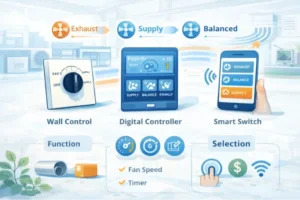
Efficient HVAC systems rely on more than just powerful fans and compressors; they depend on the precise operation of ventilation switches to regulate airflow, ensure safety, and maintain air quality. The following points outline the essential functions and selection criteria for these critical components.
With a foundational understanding of how these controls impact system performance, we can now explore the specific types of HVAC ventilation switches and their distinct operational roles.
In modern mechanical engineering, the hvac ventilation switch acts as far more than a simple on-off toggle mechanism. While the primary movers—motors, fans, and compressors—provide the muscle of an HVAC system, the switches and sensors function as the nervous system. They are responsible for detecting environmental changes, verifying mechanical action, and translating physical states into electrical signals that controllers can interpret. Without this intricate network of switching logic, even the most robust axial fans would operate blindly, leading to energy waste, mechanical failure, or compromised indoor air quality (IAQ).
To truly understand ventilation control switches, one must view them as an integrated ecosystem. A single switch does not operate in a vacuum; its state—open or closed—triggers a cascade of logic sequences. For instance, an airflow proving switch must close before a heating element engages; if it fails to close, the entire safety chain halts to prevent a fire hazard. This interdependence highlights the necessity for high-precision components that can withstand the rigors of industrial environments while providing accurate, real-time feedback to Building Automation Systems (BAS).
The fundamental technical challenge in HVAC control is bridging the gap between low-voltage logic circuits and high-voltage mechanical loads. Most modern digital controllers and thermostats operate on 24VAC or 0-10VDC signals. However, the prime movers in a commercial ventilation system—such as large exhaust fans or makeup air units—often run on 120V, 240V, or 480V three-phase power. The hvac ventilation switch often serves as the pilot device in this transaction.
When a control switch is actuated—whether by manual intervention, a timer, or a sensor—it typically energizes a coil within a relay or contactor. This magnetic action closes the high-voltage contacts, allowing line voltage to flow to the motor. This separation of circuits is critical for safety and component longevity. If a technician were to route high-voltage power directly through a delicate pressure switch, the resulting arc flash upon contact separation would likely weld the contacts together or destroy the switch mechanism immediately.
Furthermore, modern switches act as transducers. In variable air volume (VAV) systems, a binary (on/off) switch is often insufficient. Instead, engineers utilize switching mechanisms that output a continuous signal, such as 4-20mA, corresponding to variables like static pressure or temperature. This allows for modulation, where the system doesn’t just start or stop, but adjusts speed and torque to match precise load requirements.
Historically, ventilation control relied heavily on manual toggle switches and human oversight. A facility manager would physically walk the floor, turning on exhaust fans at the start of a shift and powering them down at night. This method was fraught with inefficiency. Human error often led to systems running overnight, conditioning unoccupied spaces, or failing to activate during high-load production periods, resulting in poor air quality.
The shift toward automated ventilation system controls has revolutionized how buildings breathe. Automation ensures consistency in Air Changes per Hour (ACH), a critical metric for industrial hygiene. By removing the human element, facilities can ensure that ventilation adheres strictly to occupancy schedules or environmental sensors.
Hidden Insight: The true value of automation lies in “adaptive learning.” Modern smart switches integrated with BAS can analyze trend data. If a specific zone consistently overheats at 2:00 PM, the system pre-emptively activates ventilation before the threshold is breached, reducing the peak load on mechanical cooling.
Selecting the correct hvac ventilation switch requires a deep understanding of the physical parameter triggering the actuation. Switches are generally categorized by what they sense: air movement, pressure differentials, temperature limits, or manual input. Each category plays a specific role in the safety and efficiency of air ducts and air handling units.
An airflow proving switch is a safety interlock designed to verify that air is actually moving through a duct before allowing other equipment (like electric strip heaters or gas burners) to fire. There are two primary mechanical designs used for this purpose:
| Switch Type | Mechanism | Best Application |
|---|---|---|
| Sail Switch | A lightweight paddle (sail) inserted into the airstream is pushed by airflow, closing a contact. | Low-velocity ducts, residential furnaces, simple proving. |
| Differential Pressure Switch | Senses the pressure drop across a fan or flow restriction via a diaphragm. | Commercial/Industrial systems, high-velocity ducts, VAV boxes. |
In commercial applications utilizing powerful axial fans for ventilation, differential pressure switches are preferred over sail switches. Sail switches are prone to mechanical fouling—dust buildup on the hinge can prevent the paddle from moving. A differential pressure switch, however, uses pitot tubes to measure the difference between total pressure and static pressure (velocity pressure). When the velocity pressure exceeds a setpoint (e.g., 0.05" w.c.), the switch closes. This is non-negotiable for safety; without this proof of airflow, a heating coil would rapidly overheat, potentially causing a catastrophic fire.
While similar in operation to proving switches, differential pressure switches used for static management serve a different purpose: regulation and maintenance. One of the most common applications is filter monitoring. By measuring the pressure drop across a filter bank, the switch can detect filter loading.
As particulate matter clogs the filter media, resistance increases, and the pressure drop across the filter rises. When this differential reaches a manufacturer-specified limit (e.g., 1.0" w.c.), the switch triggers a maintenance alarm. This prevents the system from running with choked airflow, which strains fan motors and reduces effective ventilation. In more advanced VAV systems, these switches monitor the static pressure within the main supply duct. If VAV boxes close off (reducing demand), duct pressure rises. The pressure switch signals the Variable Frequency Drive (VFD) to reduce fan speed, preventing duct blowout and saving energy.
HVAC fan switches have evolved from simple speed selectors (Low/Med/High) to complex interfaces for electronic commutation. In modern systems, the “switch” is often a potentiometer or a digital interface communicating with an Electronically Commutated Motor (ECM) or a VFD.
For direct-drive tubeaxial fans, speed regulation is critical for acoustic control and balancing. A simple on/off switch causes the motor to experience high inrush current (Locked Rotor Amperage) at startup, stressing the windings. Advanced control switches utilizing soft-start logic or VFD integration ramp the voltage up slowly. This capability allows the system to maintain a constant static pressure even as filters load, automatically increasing fan RPM to compensate for resistance—a feature impossible with standard toggle switches.
Limit switches act as the last line of defense against equipment destruction. In the context of ventilation, the most common is the high-limit temperature switch. These are typically bimetallic discs or capillary tubes that open an electrical circuit when the temperature exceeds a safety threshold (e.g., 200°F or 93°C).
In a gas-fired makeup air unit, the fan-limit switch coordinates the blower operation with the heat exchanger temperature. It ensures the fan does not start until the heat exchanger is warm (preventing cold drafts) and ensures the fan continues running after the burner shuts off to dissipate residual heat. Failure of this switch can lead to a cracked heat exchanger, leaking carbon monoxide into the airstream.
Effective ventilation is not just about moving air; it is about moving the right amount of air, in the right direction, at the right time. Optimization requires a strategic arrangement of hvac ventilation switches to manage pressure hierarchies within the building envelope.
Exhaust fan control strategies focus on removing contaminants while maintaining building pressure balance. A common strategy involves interlocking exhaust fans with occupancy sensors or gas detection switches. For example, in an enclosed parking garage, fans should not run continuously at full power. Instead, Carbon Monoxide (CO) and Nitrogen Dioxide (NO2) sensors act as the switches. When gas levels rise above a threshold (e.g., 25 ppm for CO), the sensors trigger the exhaust system.
Crucially, high-volume exhaust requires synchronized makeup air. If a technician installs a high-capacity exhaust fan without a corresponding switch to trigger the makeup air unit, the building will enter negative pressure. This can cause back-drafting of flue gases from water heaters and difficulty opening exterior doors. The control strategy must link the exhaust switch to the makeup air intake damper ensuring they actuate simultaneously.
Bringing in fresh air is essential for diluting indoor pollutants, but it represents a significant thermal load. Fresh air ventilation controls utilize enthalpy switches or “economizer” logic to optimize this process. An enthalpy switch measures both temperature and humidity (total heat content) of the outside air.
When outdoor conditions are favorable (e.g., cool and dry), the economizer switch signals the dampers to open fully, allowing the building to use outside air for “free cooling,” bypassing the mechanical compressors. This is a cornerstone of energy-efficient HVAC ventilation designs. However, if the outdoor air is humid or too hot, the switch locks out the economizer, keeping dampers at the minimum position required for ASHRAE 62.1 compliance to minimize the load on the cooling coil.
The most critical role of ventilation switches lies in life-safety integration. In the event of a fire, the ventilation system must transition from “comfort mode” to “smoke control mode.” This involves a complex sequence of switching operations involving fire and smoke dampers.
Upon detection of smoke, the fire alarm control panel sends a signal to relays controlling the HVAC system. Supply fans may shut down to prevent feeding oxygen to the fire, while dedicated smoke exhaust fans activate. Simultaneously, smoke dampers must close to compartmentalize the building. Essential components like rectangular smoke dampers class i leakage rated with vertical airfoil blades rely on actuator switches to verify their position. These dampers are equipped with “end switches” or auxiliary contacts. When the damper blade reaches its fully closed or open position, the end switch closes, sending a confirmation signal back to the fire command center. Without this confirmation, first responders cannot be certain that smoke containment is active.
Similarly, for different duct configurations, rectangular smoke dampers class i leakage rated with 3V blades provide a tighter seal in lower-velocity applications. The integration of these dampers with the central control switch ensures that smoke does not migrate through the ventilation shafts to unaffected floors.
The selection of control modes directly influences the Operational Expenditure (OPEX) of a facility. The days of “set it and forget it” are over; dynamic switching logic is required to meet modern energy codes.
Demand-Controlled Ventilation (DCV) represents the pinnacle of efficiency in ventilation control switches. Traditional systems operate continuously at design capacity, assuming full occupancy. DCV utilizes CO2 sensors effectively as modulation switches. Since humans exhale CO2 at a predictable rate, the concentration of the gas is a proxy for the number of people in a room.
When the room is empty, CO2 levels drop, and the controller signals the outdoor air dampers to close to their minimum setting and fans to slow down. As people enter and CO2 levels rise (e.g., approaching 1000 ppm), the system ramps up. This approach prevents the conditioning of ventilation air that isn’t actually needed. Looking forward, future trends in smart systems suggest that AI-driven predictive switching—which accounts for weather forecasts and historical occupancy data—will further refine DCV strategies.
There is an inherent tension between IAQ and energy efficiency. More ventilation generally equals better air quality but higher energy bills. Smart switches allow facility managers to navigate this trade-off. By utilizing scheduling switches and occupancy sensors, systems can perform a “flush out” cycle early in the morning using cool outside air, improving IAQ before occupants arrive without running compressors.
Furthermore, understanding the main types of ventilation systems—exhaust, supply, balanced, and energy recovery—allows engineers to select the right switching logic. For instance, in an Energy Recovery Ventilation (ERV) system, a frost-protection switch is vital. If the exhaust air is too cold, it could freeze the heat exchanger core; the switch detects this and triggers a defrost cycle or bypass damper, sacrificing momentary efficiency to protect the expensive hardware.
Choosing the right switch is not merely about fit; it is about electrical and environmental compatibility. A mismatch here can lead to premature failure or dangerous electrical faults.
Technicians must differentiate between resistive loads (heaters) and inductive loads (motors, solenoids). Inductive loads create a high inrush current upon startup and a voltage spike (back EMF) upon disconnect. A switch rated for 10 Amps Resistive may only be rated for 2 Amps Inductive (or Pilot Duty). Using an under-rated switch to control a fan motor directly will cause the contacts to pit and weld due to arcing.
When dealing with larger motors, such as those found on belt-driven tubeaxial fans, the switch should never carry the motor load directly. Instead, the switch should control a magnetic starter or contactor. The switch handles the low-amperage coil voltage (control circuit), while the contactor handles the high-amperage motor load (power circuit). Technicians must check the LRA (Locked Rotor Amps) and FLA (Full Load Amps) ratings of the motor and ensure the pilot device is compatible with the contactor coil’s inrush requirements.
The physical environment dictates the NEMA rating of the switch enclosure. A standard NEMA 1 enclosure is suitable for a clean electrical room but will fail rapidly if installed on a rooftop exhaust fan or in a wash-down area. For outdoor applications or areas with high humidity, a NEMA 3R (Rainproof) or NEMA 4/4X (Watertight/Corrosion Resistant) enclosure is mandatory.
Additionally, sensor drift is a concern in harsh environments. Switches exposed to extreme temperature fluctuations or vibration may lose calibration over time. Industrial-grade switches often feature potted electronics to resist moisture and vibration, ensuring that the setpoint remains accurate (e.g., maintaining a precise 0.03" w.c. trigger point) despite the harsh conditions.
The type of fan drive influences the choice of failure detection switch. In direct-drive systems, the motor and fan spin at the same speed; if the motor turns, the fan turns. Current sensing switches (CS) are excellent here—if the motor draws current, it is running.
However, for belt-driven systems, a current sensing switch can be deceptive. If the belt breaks, the motor will continue to spin (drawing low amperage), but the fan wheel will be stationary. The BMS will “think” the fan is running because the motor has power. Therefore, for belt-driven units, a differential pressure switch or a physical rotation sensor is the only reliable way to prove actual airflow. This distinction is vital when configuring BromingHvac systems for critical applications where airflow loss must trigger an immediate alarm.
Even the highest quality switch will fail to perform if installed incorrectly. Turbulence, vibration, and electrical interference are the enemies of precision sensing.
For pressure switches and airflow sensors, placement is paramount. Probes should be installed in areas of laminar flow to get a stable reading. A common rule of thumb is to place static pressure probes at least 3 to 5 duct diameters downstream from any elbow, transition, or fan discharge. Placing a sensor in a turbulent zone (the “dead zone” or eddy currents right after a bend) will result in erratic switching, causing the fan to surge or the burner to short-cycle.
Additionally, the orientation of the switch matters. Some diaphragm switches are gravity-sensitive; mounting them vertically versus horizontally can shift the actuation point by 0.05" w.c. or more. Technicians must verify the manufacturer’s mounting instructions, specifically regarding the position of the diaphragm relative to the ground.
When a ventilation system fails to start, the control switches are often the first suspects. A systematic troubleshooting workflow is essential:
By treating the hvac ventilation switch as a precision instrument rather than a commodity part, HVAC professionals can ensure robust, efficient, and safe system operation.
As we have explored, the HVAC ventilation switch is far more than a simple component; it is the critical interface between mechanical power and intelligent control. While motors and fans provide the necessary force to move air, it is the sophisticated network of switches and sensors that ensures this energy is used safely, efficiently, and effectively. From simple manual toggles to complex differential pressure sensors, these devices form the nervous system of modern building automation.
Understanding the intricate relationship between electrical signals and mechanical action is paramount for any HVAC professional. Whether you are managing industrial exhaust systems or fine-tuning commercial climate control, the reliability of your operation hinges on the precision of these switching mechanisms. They transform raw voltage into actionable logic, protecting equipment from catastrophic failure and ensuring that indoor environments remain safe for occupants.
The most vital function of ventilation switches lies in their role as safety interlocks. In high-stakes environments, there is no room for error. Devices like airflow proving switches and high-limit temperature sensors act as the guardians of the system, preventing hazardous conditions such as overheating or the buildup of toxic gases.
For systems integrating life-safety components, such as fire and smoke dampers, the reliability of the actuator switch is a matter of code compliance and occupant survival. These switches verify that containment measures are active during an emergency, providing first responders with accurate status updates. By ensuring that your system utilizes the correct detection logic—whether through sail switches for residential units or differential pressure sensors for industrial applications—you safeguard both the physical asset and the people within the building.
Beyond safety, the evolution of switching technology has unlocked new levels of energy efficiency. The shift from constant volume systems to Demand-Controlled Ventilation (DCV) has revolutionized operational expenditures. By utilizing environmental sensors to modulate fan speeds and damper positions, modern systems only condition the air that is actually required.
This “adaptive learning” capability allows facility managers to balance the competing demands of Indoor Air Quality (IAQ) and energy consumption. Integrating these smart controls into your HVAC ventilation designs ensures that you are not wasting energy conditioning empty spaces. Whether it is optimizing fresh air intake via economizers or regulating fan speed through VFD integration, intelligent switching is the key to a sustainable and cost-effective operation.
The difference between a robust system and a failing one often comes down to the technical details of component selection. As discussed, distinct applications require distinct solutions. A switch designed for a direct-drive unit may fail to detect a broken belt on a tubeaxial fan belt driven system. Recognizing the nuances of inductive loads, inrush currents, and environmental NEMA ratings is essential for preventing premature component failure.
Furthermore, proper installation practices—such as avoiding turbulent airflow zones within air ducts—ensure that these sensitive instruments perform accurately. A high-quality switch installed in the wrong location is just as ineffective as a broken one. Technicians must view these components as precision instruments that require careful placement and calibration to function correctly within the broader ecosystem of the building.
Ultimately, the effectiveness of any ventilation strategy relies on the quality and configuration of its control switches. These devices bridge the gap between intent and reality, ensuring that fans spin when needed, heaters fire safely, and dampers close securely. As technology advances, we can expect even tighter integration with smart building networks, predictive maintenance, and AI-driven optimization.
To maximize the lifespan and efficiency of your mechanical equipment, prioritize high-quality control components and strategic system design. Whether you are upgrading an existing facility or designing a new installation, BromingHvac offers the expertise and industrial-grade solutions required to keep your environment comfortable, compliant, and efficient. Treat your ventilation switches with the importance they deserve, and your HVAC system will deliver reliable performance for years to come.