Need Specifications or a Quote?
Share your ventilation project requirements and our engineers will reply within 12 hours with technical specs, pricing, and lead time.


Effective ventilation is crucial for maintaining air quality, energy efficiency, and occupant comfort in any building. But what are four types of ventilation systems, and how do you choose the right one for your needs? Each system—natural, mechanical, exhaust, and energy recovery—offers unique advantages based on functionality and application. Understanding the core principles and benefits of these HVAC ventilation systems helps ensure informed decisions for residential or commercial spaces.
Let’s explore how these systems work and what factors to consider when selecting the ideal solution for optimal air exchange and performance.
Ventilation is an essential aspect of maintaining healthy indoor air quality, whether for residential or commercial buildings. By understanding the characteristics and applications of the four primary types of ventilation systems—natural, mechanical, exhaust, and energy recovery ventilation—this guide provides actionable insights. Below, we break down the essential concepts, including how these systems operate, their unique advantages, and how hybrid solutions can address specific environmental needs.
By exploring these ventilation systems individually and in combination, you can make informed decisions to ensure energy efficiency, comfort, and high air quality tailored to your building’s unique needs. In the sections ahead, we’ll examine practical applications, benefits, and strategies for optimizing ventilation solutions in different contexts.
When professionals ask, What are four types of ventilation?, they are usually referring to the four foundational categories used in modern buildings: natural ventilation, mechanical ventilation, exhaust ventilation, and energy recovery ventilation as part of balanced mechanical systems. These four types of ventilation give designers the basic toolkit for moving air through a building, controlling contaminants, and managing heat and moisture.
At the core of all HVAC ventilation systems is the concept of air exchange. Air exchange describes how quickly indoor air is replaced with outdoor air, typically expressed as ACH (air changes per hour). For example, an ACH of 3 means the total volume of air in a space is theoretically replaced three times every hour. Codes and standards such as ASHRAE 62.1 and 62.2 define minimum ACH or outdoor airflow rates for different occupancies to protect indoor air quality, manage CO₂ levels, and dilute VOCs and other pollutants.
Ventilation is not just about fresh air; it is also a primary control mechanism for moisture and condensation. In cold climates, incorrect ventilation strategies can lead to interstitial condensation and mold within envelopes. In warm, humid climates, uncontrolled infiltration and poorly designed exhaust systems can drive latent loads and cause comfort and durability issues. This is why the question what are the different types of HVAC ventilation systems is tightly connected to building physics, climate, and envelope design rather than being a purely mechanical choice.
From a system perspective, the four types of ventilation sit along a spectrum. Natural ventilation uses no fans and relies entirely on wind and buoyancy. Mechanical ventilation types, including supply-only, exhaust-only, and balanced systems, use fans and Air ducts to move air in predictable ways. Exhaust ventilation focuses on removing contaminated air from specific zones, often as a subset of mechanical systems, while energy recovery ventilation adds heat and sometimes moisture exchange to improve efficiency. Together they form the basis of modern ventilation strategies in both residential and commercial projects.
In practice, selection of these systems differs between small homes and large commercial buildings, but the underlying principles are the same. Resources such as HVAC basics are useful for aligning envelope design, equipment, and control sequences so that ventilation performance, energy use, and comfort are all optimized. With this context, it becomes easier to examine each of the four main types and understand where they succeed, where they struggle, and how they can be combined in hybrid solutions.
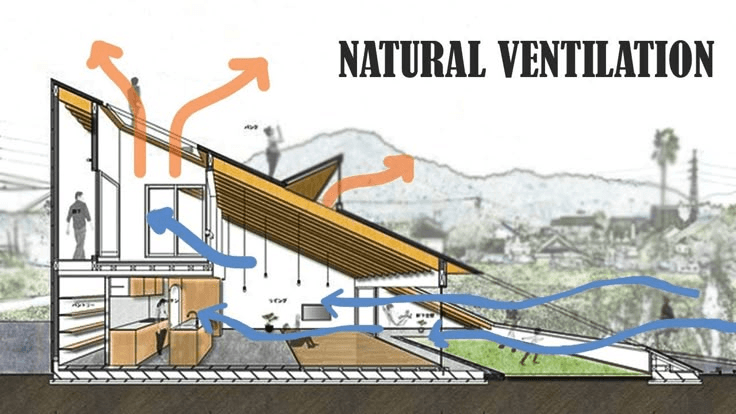
Natural ventilation is the oldest of the four types of ventilation and operates without fans. Instead, it harnesses two physical drivers: wind pressure and the stack effect (thermal buoyancy). When wind strikes a building, it creates positive pressure on the windward side and negative pressure on the leeward side. If there are openings on both sides—such as operable windows, vents, or louvers—air naturally flows from the high-pressure side to the low-pressure side, delivering cross-ventilation.
The stack effect is driven by temperature differences between indoor and outdoor air. Warm air is less dense and tends to rise. In a building with low-level inlets and high-level outlets (such as clerestory windows, roof vents, or atria), warmer indoor air will rise and escape at the top while drawing in cooler outside air at the bottom. The greater the temperature difference and vertical separation between openings, the stronger the stack-driven air exchange.
Natural ventilation systems typically rely on building elements rather than mechanical equipment. These include operable façade windows, trickle vents, ventilation chimneys, courtyards, and atria. The performance of such systems is highly sensitive to the size, placement, and control of openings, as well as external factors like urban wind patterns and outdoor air quality. Guidance from resources like HVAC basics can help ensure that aperture sizing and orientation achieve minimum target ACH while maintaining comfort.
The primary advantage of natural ventilation is very low energy consumption. With no fans and minimal mechanical infrastructure, operating costs are effectively zero aside from automated window actuators or control systems. There is also a qualitative comfort benefit; occupants often perceive naturally ventilated spaces as fresher and more pleasant due to air movement and connection with the outdoors.
However, the limitations are significant. The system’s performance is weather-dependent, so airflow can be minimal during periods of low wind or small indoor-outdoor temperature differentials. In polluted or noisy urban environments, opening windows may be undesirable or impossible. Security, insects, and driving rain can also constrain when and how openings can be used. These constraints place a practical limit on relying solely on natural ventilation for code-required fresh air in many building types.
Natural ventilation is most successful in temperate climates with moderate temperatures and good outdoor air quality, and in buildings with relatively low internal gains and relaxed control requirements. Typical applications include single-family homes, low-rise schools, small office buildings, and community facilities where occupants can adjust windows and are tolerant of some variation in temperature and air movement.
Best practice design strategies emphasize capturing wind and promoting cross-ventilation. This often includes aligning windows on opposite façades, using open floor plans or interior transom windows, and placing operable openings at both low and high levels to enable stack effect. Night flushing is another common technique: windows and vents are opened at night to purge heat from thermal mass, reducing cooling loads the following day.
From a “natural vs mechanical ventilation comparison” standpoint, natural-only approaches are most viable where internal loads and peak occupancies are modest and where codes allow performance-based or mixed-mode compliance. In dense urban high-rises, labs, hospitals, and other critical facilities, the lack of control and filtration usually makes fully natural ventilation insufficient for meeting modern performance requirements.
Consequently, many projects adopt a hybrid strategy that combines natural and mechanical ventilation. For example, a school might use natural cross-ventilation through operable windows during mild seasons and low occupancy, and switch to mechanical systems during extreme temperatures or high occupancy events. Controls can be integrated to lock out window openings when mechanical cooling or heating is at full capacity. This hybrid approach effectively bridges the gap between low-energy operation and robust, predictable performance, setting the stage for more advanced mechanical and energy recovery systems in the overall design.
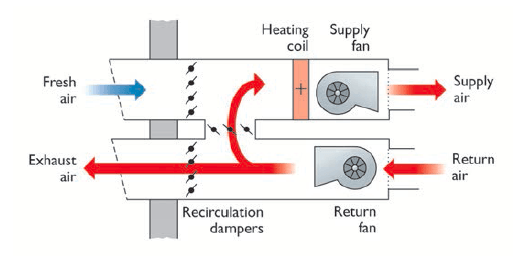
Mechanical ventilation encompasses several distinct mechanical ventilation types that differ primarily in how they move air into and out of the building. These include supply-only, exhaust-only, and balanced ventilation systems. Understanding how each works is essential when asking, how does mechanical ventilation work in buildings and where should each type be applied.
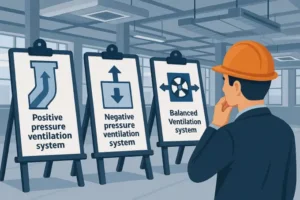
In supply-only systems, fans introduce outdoor air into the building, often via a central air handler or dedicated outdoor air unit. The incoming air is distributed through Air ducts and discharged via diffusers or grilles and registers. The building envelope and incidental openings act as relief paths for air to escape. Supply-only systems tend to create slight positive indoor pressure, which can help limit infiltration of unconditioned or contaminated air.
Exhaust-only systems use fans to remove air from the building without actively supplying outdoor air, relying on infiltration and passive openings for makeup air. These are commonly used in bathrooms, kitchens, and localized process areas and are discussed more fully in the following section. They tend to create slight negative pressure, which can be beneficial for containing contaminants but problematic if unfiltered or humid air is drawn through the envelope.
Balanced ventilation systems use fans to both supply outdoor air and exhaust indoor air in roughly equal quantities. This maintains near-neutral building pressure and provides a high degree of control over airflow paths and volumes. In many modern designs, balanced systems incorporate energy recovery ventilation, using heat or enthalpy exchangers to transfer energy between the outgoing and incoming airstreams.
All mechanical ventilation systems rely on a combination of fans, ductwork, terminal devices, and controls. Fans may be centrifugal or axial; in many applications, Axial Fans are used for exhaust, smoke control, or supply where large volumes and relatively low static pressures are required. Ducts are typically constructed from air ducting sheet metal or flexible materials and sized to limit pressure drop and noise while delivering design airflow.
In buildings with fire compartments or smoke control requirements, Fire smoke dampers are integrated where ducts penetrate fire-rated assemblies, ensuring that the mechanical ventilation system does not compromise life-safety barriers. Overall, mechanical systems are the primary answer to the question what are the different types of HVAC ventilation systems when tight control, filtration, and code compliance are required.
The most significant advantage of mechanical ventilation is control. Designers can specify target ACH or outdoor airflow per person and per floor area, then size fans and ducts to deliver these volumes regardless of wind conditions or minor temperature differences. This enables predictable indoor air quality and compliance with stringent standards and certifications.
Mechanical systems also integrate filtration. By passing outdoor air through filters before distributing it via ductwork, pollutants such as particulates, pollen, and some gaseous contaminants can be effectively reduced. For offices, schools, healthcare facilities, and residential buildings in urban environments, filtration is a critical benefit that natural ventilation alone cannot provide.
Another strength is independence from weather and acoustics. Sealed, energy-efficient building envelopes can remain closed for much of the year, avoiding noise and outdoor pollution while still achieving required air exchange. This is particularly important for high-performance buildings that aim to minimize infiltration and exfiltration to control energy use and moisture migration.
Mechanical systems do come with tradeoffs. Energy consumption is higher due to fan power and, when air is conditioned, due to the added heating or cooling loads associated with ventilation air. Proper design of Air ducts, selection of efficient fans, and careful balancing can mitigate these penalties. Noise from fans and air movement must be managed through duct layout, attenuation, and diffuser selection. Maintenance is also non-trivial: filters, fans, and dampers require periodic inspection and replacement.
Despite these costs, mechanical ventilation is the backbone of modern whole-house ventilation and commercial strategies, and forms the platform on which more specialized solutions like balanced ventilation with energy recovery are built. As the next section explains, exhaust systems are a critical sub-category within mechanical approaches that deserve focused attention.
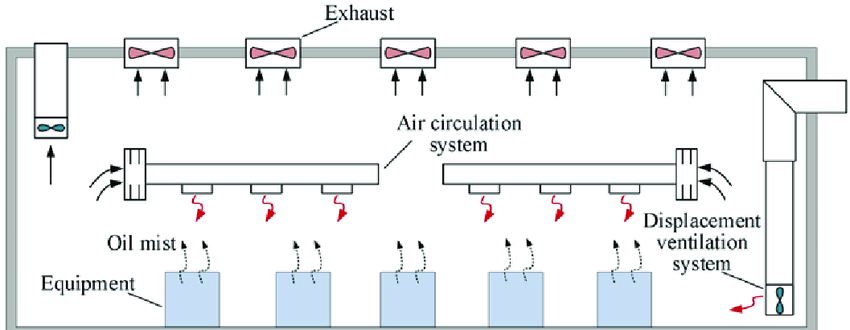
Exhaust systems are both their own category and a subset within the four types of ventilation. They are defined by their primary function: to remove air from specific zones and discharge it outdoors. In most cases, they are mechanically driven, using dedicated exhaust fans or Axial Fans connected to localized ductwork.
In residential and light commercial buildings, bathroom fans and kitchen range hoods are the most familiar forms of exhaust systems. In industrial or laboratory settings, exhaust may include fume hoods, process exhaust, and general exhaust from high-contaminant areas. These systems capture pollutants at or near the source, which is far more effective than attempting to dilute them through general ventilation alone.
To function properly, exhaust systems require pathways for replacement air to flow into the occupied zone. This makeup air can be provided by dedicated supply systems, transfer air from adjacent spaces, or infiltration through the envelope. Components such as Return grilles and other grilles and registers allow air to move from corridors or other rooms into the exhaust zone, maintaining airflow patterns and avoiding uncomfortable drafts.
Performance of exhaust-only systems is typically evaluated in terms of airflow rates (CFM or L/s), capture efficiency for localized sources, and the resulting building or zone pressure. If exhaust airflow exceeds available makeup air, the space can become significantly negative, which has both benefits and risks. Negative pressure is often intentional in restrooms and certain healthcare spaces to contain odors and contaminants, but it must be controlled and supported by adequate makeup air design.
While exhaust-only is simple and cost-effective, it poses several design challenges. One of the most important is the potential for uncontrolled negative pressure. In cold climates, excessive negative pressure can draw in very cold outdoor air through envelope leaks, increasing heating load and causing condensation within wall assemblies. In some cases, it can also backdraft combustion appliances if they are not sealed, creating serious safety hazards.
In humid regions, negative pressure can pull moist outdoor air into wall cavities where it may condense on cooler interior surfaces, leading to mold and durability problems. For buildings over garages or near contaminated soils, exhaust-only systems can inadvertently draw in soil gases such as radon or vapors from fuels and solvents. These risks are magnified when makeup air is not clearly defined or when exhaust volumes are significantly increased without rebalancing the system.
Another drawback of simple exhaust systems is the energy penalty. Conditioned indoor air—heated or cooled—is exhausted directly outdoors, and the incoming replacement air is untreated. Without any form of heat or energy recovery, this can significantly increase heating and cooling loads, especially in extreme climates. In many jurisdictions, this has driven a shift away from exhaust-only for whole-house ventilation toward balanced or energy recovery systems.
Maintenance is also a key consideration. Exhaust fans and ductwork often accumulate grease, dust, and other contaminants, which reduce airflow and efficiency. Regular cleaning and inspection of fans, ducts, and terminals such as Return grilles are essential to sustain design performance over the life of the building.
For localized pollutant control—kitchens, bathrooms, certain process areas—exhaust-only remains appropriate and cost-effective. For general ventilation, however, many projects now favor balanced ventilation with some level of energy recovery ventilation to control pressure and energy use, a topic explored in the next section.
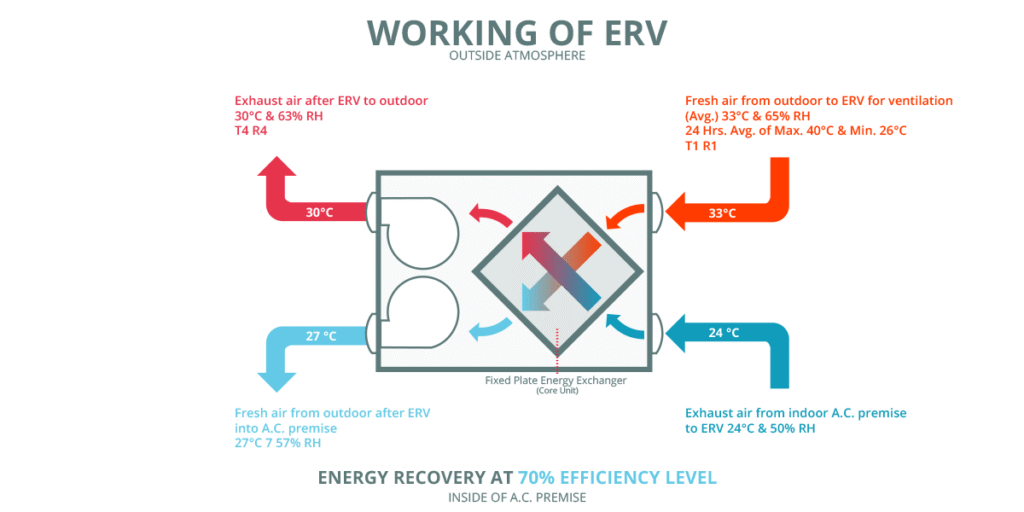
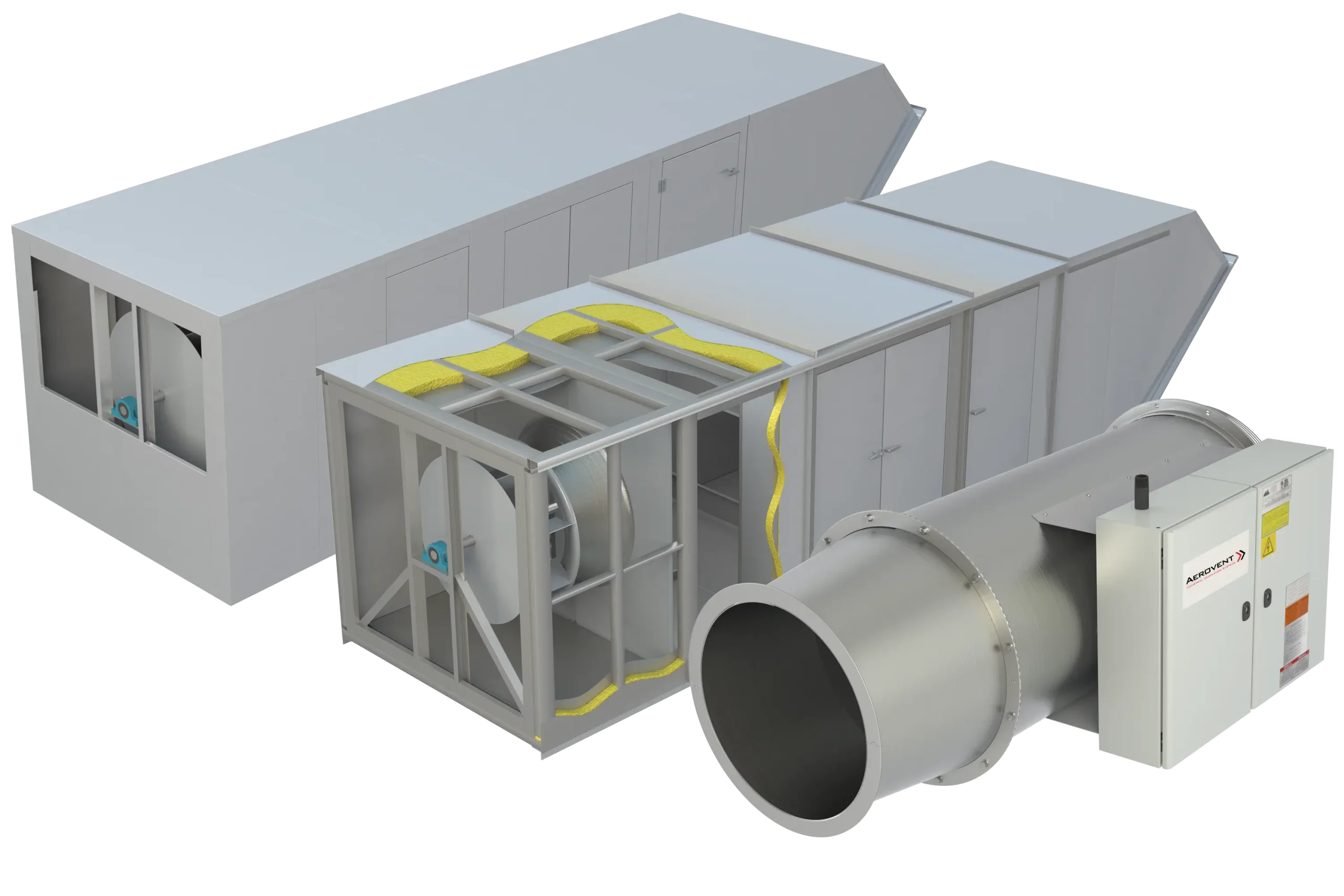
Energy recovery ventilation (ERV) systems are an advanced form of balanced mechanical ventilation. They use specialized heat exchangers to transfer energy between the outgoing exhaust air and the incoming outdoor air stream. In doing so, ERVs dramatically reduce the extra heating or cooling load associated with mandatory ventilation air and are often the answer to the question, which ventilation system is most energy efficient, especially in cold or hot-humid climates.
Most ERVs include two fans—one for supply, one for exhaust—and a core that facilitates heat transfer. Common energy transfer technologies include plate heat exchangers, rotary enthalpy wheels, and fixed-core enthalpy exchangers. In cold climates, the warm exhaust air preheats the incoming outdoor air, while in hot climates the cooler exhaust air precools the incoming air. Many ERVs are designed as enthalpy exchangers, meaning they also transfer moisture, reducing latent loads on downstream cooling equipment.
As a result, ERVs provide balanced ventilation while maintaining near-neutral building pressure. Supply and exhaust flows are matched, and the heat exchanger imposes only modest additional pressure drop, which is accounted for in fan selection and duct design. The ducted distribution network typically uses Air ducts and terminals such as Heavy-duty grilles or standard grilles and registers to deliver and remove air from occupied zones.
From a control perspective, ERVs can operate at constant volume, demand-controlled (using CO₂ or occupancy sensors), or integrated with broader building management systems. Their efficiency is characterized by sensible effectiveness and, where applicable, latent effectiveness. Well-designed ERVs can recover 60–80% of the sensible energy and 50–70% of the latent energy that would otherwise be lost in a traditional balanced system.
ERVs are particularly attractive in buildings with airtight envelopes and high-performance aspirations—such as Passive House residences, deep energy retrofits, and advanced commercial facilities. In such buildings, uncontrolled infiltration is minimized, so mechanical ventilation must carry the full load of air exchange. Without energy recovery, the resulting heating and cooling penalties can be substantial.
In cold climates, an ERV can reduce ventilation-related heating loads by 50–80%, often yielding annual energy savings on the order of 15–30% for small commercial buildings and high-performance homes. For example, a multi-unit residential building in a Canadian climate that replaced exhaust-only systems with central ERVs and balanced ductwork reported a 25% reduction in space heating energy, equating to more than $150,000 in annual savings while simultaneously improving indoor air quality through consistent, filtered outdoor air.
In hot-humid regions, ERVs limit the moisture load on cooling coils by preconditioning outdoor air before it enters the main air-handling unit. This reduces latent cooling requirements, improves indoor humidity control, and can allow downsizing of chillers or DX equipment. Occupant comfort benefits from more stable temperature and humidity, along with quieter operation because windows can remain closed without sacrificing fresh air.
The primary tradeoffs of ERVs are higher first cost and system complexity. The heat exchanger cores, additional controls, and more extensive ductwork add capital cost relative to simple exhaust-only or supply-only systems. Careful detailing is required to prevent frosting in cold climates and cross-contamination between airstreams. Maintenance includes periodic cleaning of the core and replacement of filters on both supply and exhaust sides to protect performance.
Despite these complexities, ERVs are increasingly common answers when designers ask what are the different types of HVAC ventilation systems that can meet tight energy codes and green building certifications. They provide a strong bridge between energy efficiency, IAQ, and comfort, and they integrate well with the broader mechanical infrastructure—ducts, grilles, and controls—already present in most commercial and multi-residential buildings.
Selecting between the four types of ventilation—and often combining them—requires a structured evaluation of climate, building type, occupancy, and regulatory context. When practitioners explore how do I choose between different ventilation systems, a few key factors consistently shape the decision.
Climate zone is fundamental. In cold climates, uncontrolled exhaust or natural ventilation can impose significant heating penalties and risk condensation within the envelope, making energy recovery ventilation or at least balanced systems highly attractive. In hot-humid climates, the priority is often limiting latent loads and preventing humid outdoor air from entering uncontrolled, again pointing toward balanced or ERV systems. In mild or mixed climates, hybrid solutions that mix natural ventilation during shoulder seasons with mechanical or ERV systems during extremes can be highly effective.
Building type and use are equally important. Single-family homes with responsive occupants may accept natural ventilation and localized exhaust, whereas hospitals and laboratories require tightly controlled, fully mechanical systems. Offices, schools, and multifamily buildings often fall somewhere in between, with a mix of local exhaust, centralized mechanical ventilation, and sometimes natural ventilation features.
Occupancy patterns and internal loads drive the required ACH and air distribution approach. Densely occupied spaces, high internal gains, or sensitive activities (such as laboratories or data centers) generally necessitate mechanical or ERV solutions with robust filtration and controls. Lightly occupied or intermittently used spaces may be good candidates for natural ventilation as part of a hybrid strategy.
Regulatory and energy code requirements also influence system choice. Many jurisdictions have adopted stringent codes that effectively discourage exhaust-only whole-house ventilation due to energy waste, instead driving adoption of balanced or ERV systems. Budget, both capital and operational, must be weighed against performance goals and payback periods.
Real-world case studies, like those described in HVAC project insights, often show that hybrid solutions outperform single-strategy designs. For instance, an office in a mixed climate may use controlled natural ventilation via operable windows and atria when outdoor conditions are favorable, then switch to a balanced ERV system coupled with mechanical cooling during hot or cold extremes. This approach can yield 20–30% overall HVAC energy savings compared with a purely mechanical baseline while maintaining code-compliant indoor air quality.
Ultimately, answering what are the four types of ventilation is only the first step. The more critical design question is how to integrate natural, mechanical, exhaust, and energy recovery systems into a coherent ventilation strategy tailored to the project’s climate, program, and performance goals.
In residential design, the focus is often on whole-house ventilation that ensures consistent, code-compliant air exchange throughout the year. Homeowners and designers frequently ask, Which ventilation system is best for residential buildings?, and the answer depends on a combination of climate, construction type, and budget.
For smaller homes in mild climates with operable windows and modest airtightness, a combination of natural ventilation and localized exhaust (bathroom fans, range hood) may be acceptable, especially in older construction. However, as building envelopes become tighter for energy efficiency, relying solely on natural ventilation becomes risky; infiltration decreases, and indoor pollutants can accumulate without a defined ventilation strategy.
Exhaust-only whole-house systems, using multiple continuously operating exhaust fans, are relatively inexpensive and easy to retrofit. Yet they can create negative pressure, draw in contaminants from garages or crawlspaces, and waste conditioned air. For cold and hot-humid climates, this approach is increasingly seen as suboptimal, particularly where energy codes are tightening.
Supply-only systems that bring filtered outdoor air into a central air handler and distribute it through Air ducts can provide positive pressure and relatively good IAQ, as long as ductwork is well-sealed and properly balanced. When combined with appropriately selected Fire smoke dampers and distribution terminals, supply-only systems can be integrated into existing forced-air heating and cooling equipment with moderate additional cost.
Balanced ventilation systems, including simple HRVs (heat recovery ventilators) and more advanced ERVs, are widely regarded as the best long-term solution for new, airtight homes, particularly in cold or hot-humid climates. They deliver filtered outdoor air, exhaust stale indoor air, maintain near-neutral pressure, and recover a substantial portion of the energy that would be lost in exhaust-only systems. For a typical high-performance home, moving from exhaust-only to a well-designed ERV can cut ventilation-related heating and cooling energy by 40–60%, with paybacks in the 5–10 year range depending on energy prices.
From a “natural vs mechanical ventilation comparison” perspective, residential projects increasingly adopt mixed-mode strategies: windows and natural ventilation are used opportunistically during mild conditions for comfort and perceived freshness, while a balanced ERV system provides the baseline, code-required fresh air year-round. This ensures robust IAQ even when occupants do not—or cannot—open windows due to weather, security, or outdoor pollutants.
In practical terms, components like Axial Fans may be used in roof-mounted exhaust configurations or in larger multifamily projects for centralized exhaust risers. Air ducts form the backbone of distribution, carrying supply air to bedrooms and living areas and returning stale air from bathrooms, kitchens, and utility spaces through appropriate terminals and, where applicable, Fire smoke dampers to maintain compartmentation.
For single-family homes, a typical hierarchy of options looks like this:
For multifamily buildings, central balanced or ERV systems serving multiple units via shared ductwork are often the most cost-effective over the building’s life. Project teams can refer to HVAC project insights and foundational resources such as HVAC basics to align envelope, mechanical systems, and control strategies so that the chosen ventilation approach—whether natural, mechanical, exhaust, energy recovery, or a hybrid—meets both regulatory requirements and occupant expectations for modern residential comfort.
Understanding the four main types of ventilation systems—natural, mechanical, exhaust, and energy recovery—is essential for designing effective indoor air strategies tailored to climate, building type, and occupant needs. While natural ventilation offers energy savings and comfort, mechanical systems ensure precise control and filtration, and energy recovery ventilation optimizes efficiency. Exhaust systems remain vital for localized pollutant removal. Hybrid approaches, combining these methods, often deliver the best balance between performance, energy savings, and occupant satisfaction. By leveraging resources like HVAC Basics or HVAC Project Insights, professionals can craft ventilation solutions that enhance air quality, comply with regulations, and support sustainability goals.