Need Specifications or a Quote?
Share your ventilation project requirements and our engineers will reply within 12 hours with technical specs, pricing, and lead time.


The axial fan is a cornerstone of modern air-handling technology, responsible for everything from cooling critical data centers to ensuring occupant comfort in large commercial buildings. While its fundamental purpose—moving large volumes of air—seems straightforward, its performance is governed by a complex interplay of aerodynamic principles, mechanical design, and system dynamics. Understanding these technical nuances is not just an academic exercise; it is essential for engineers, system designers, and technicians aiming to optimize performance, maximize energy efficiency, and ensure long-term reliability. Misapplication or improper selection can lead to significant consequences, including excessive energy consumption, elevated noise levels, and premature system failure. This guide moves beyond a surface-level overview to provide a comprehensive technical exploration of how an axial fan truly works, from blade-level aerodynamics to its integration within complex HVAC systems.
At its core, an axial flow fan operates by using rotating blades to create a pressure difference, discharging air parallel to the fan’s rotational axis. This characteristic makes it exceptionally suited for high-volume, low-pressure applications common in general ventilation systems. However, achieving optimal airflow efficiency depends entirely on the meticulous engineering of its components. The geometry of the fan blades—including their pitch, chord length, and airfoil shape—directly dictates the fan’s pressure capabilities, flow rate, and acoustic signature. Furthermore, design parameters like the hub-to-tip ratio must be carefully balanced to generate sufficient pressure without sacrificing volume or pushing the fan into an unstable operating range. A failure to manage these variables can lead to stall, a critical condition where airflow separates from the blade surfaces, causing a sudden drop in performance and a surge in noise and vibration.
Translating theoretical knowledge into practical application is the final, crucial step. The market offers several types of axial fans, each engineered for specific conditions. Simple propeller fan designs excel in low-resistance environments, while more robust tubeaxial and vaneaxial fans are built for ducted systems that present higher static pressure. The key to successful selection lies in the ability to accurately read and interpret a fan performance curve, a graphical tool that maps the relationship between airflow, static pressure, power consumption, and efficiency. By analyzing this curve, an engineer can pinpoint the fan’s Best Efficiency Point (BEP) and ensure it aligns with the system’s requirements. This data-driven approach is central to modern axial fans in HVAC, where these units are vital for moving air through condensers, air handling units, and cooling towers. In this guide, we will break down each of these critical concepts, providing the technical insights needed to design, select, and operate axial fans for peak performance.
Axial fans are foundational components in countless ventilation and cooling systems, engineered to move large volumes of air efficiently. Understanding their design principles, performance characteristics, and application-specific nuances is crucial for optimizing any air-handling system. These key takeaways distill the essential technical knowledge needed to master axial fan technology, from core mechanics to advanced efficiency strategies.
From fundamental airflow principles to the intricate details of blade design, the performance of an axial fan is a product of careful engineering. In the following guide, we will provide a comprehensive technical exploration of these concepts, offering detailed insights into design parameters, performance analysis, and best practices for application in HVAC and industrial settings.
To grasp the engineering behind an axial fan, one must first understand its fundamental working principle. This device, ubiquitous in everything from computer cooling to large-scale industrial ventilation, is a masterpiece of aerodynamic simplicity and effectiveness. Its design is singularly focused on moving large volumes of air or gas with relatively low pressure changes. This section breaks down the aerodynamic process that defines its operation and introduces the essential components that work together to achieve efficient airflow, providing a foundational knowledge for system designers and technicians alike.
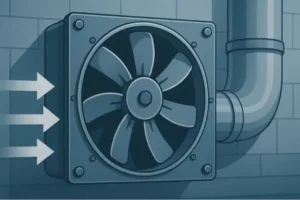
An axial flow fan operates by using a rotating impeller with blades designed like airfoils, conceptually similar to an airplane’s wing or a boat’s propeller. As the blades spin, they create a pressure difference between the front (suction side) and back (pressure side) surfaces. This pressure differential is generated based on Bernoulli’s principle; the curved surface of the blade forces air to travel a longer path, increasing its velocity and decreasing its pressure relative to the flatter side. This resulting pressure gradient creates a net force, or “lift,” on the air particles. This lift propels the air forward, drawing it into the fan and accelerating it outward. Crucially, the air is discharged in a direction parallel to the fan’s axis of blade rotation, hence the name “axial.” This linear airflow direction is what makes these fans exceptionally effective at moving large volumes of air in low-pressure environments, such as a general ventilation system for a warehouse or a parking garage. The primary function is to generate high flow rates, measured in cubic feet per minute (CFM), rather than high static pressure, measured in inches of water gauge (in. wg).
The performance of an axial fan is not just about the blades; it’s the result of a precisely engineered system of components. Understanding each part is key to appreciating the fan’s overall function, reliability, and suitability for a specific application. A failure or poor design in any one of these components can compromise the entire system’s efficiency.
The synergy between these components determines the fan’s overall performance curve, noise profile, and operational lifespan, forming the basis for proper fan selection and system integration.
The efficiency and effectiveness of an axial fan are not accidental; they are determined by specific design choices made during its engineering phase. These parameters directly influence its capacity to move air (flow rate), overcome system resistance (static pressure), consume power, and generate noise. A deep understanding of these factors is essential for any engineer or technician looking to select the perfect fan for a given application or to diagnose performance issues in an existing system. Mastering these concepts is the first step to improve airflow efficiency and reduce operational costs.
The geometry of the fan blades is the single most important factor influencing fan performance. The airfoil shape of each blade is designed to generate lift with minimal drag. However, several other geometric properties are fine-tuned to achieve specific outcomes in the balance between flow, pressure, and efficiency.
CFM) and the static pressure the fan can generate. However, this comes at a cost: it also demands more power from the motor and tends to increase turbulence and noise. Some advanced industrial axial fan models feature adjustable-pitch blades, allowing for on-site tuning to precisely match system requirements, though at a higher initial cost.Among the most impactful yet often overlooked axial fan design parameters and performance metrics is the hub-to-tip ratio. Defined as the ratio of the hub’s diameter (Dh) to the impeller’s total tip-to-tip diameter (Dt), this parameter fundamentally dictates the fan’s aerodynamic capabilities and its suitability for different types of applications.
Understanding the hub-to-tip ratio allows an engineer to quickly assess whether a fan is fundamentally designed for high-volume circulation or for pressure-intensive ducted ventilation, guiding the selection process from the very start.
Selecting the right axial fan requires more than just knowing its physical design; it demands a data-driven analysis of its performance characteristics under real-world conditions. This involves learning how to interpret manufacturers’ data to predict performance accurately. This section covers how to decipher fan curves to optimize selection and how to understand and prevent critical aerodynamic failure modes like stall, which can lead to inefficiency, noise, and mechanical damage.
A fan performance curve is a graphical chart provided by the manufacturer that illustrates the complex relationship between airflow (CFM), static pressure (in. wg), brake horsepower (BHP), and efficiency (%) for a specific fan model at a constant speed (RPM). By analyzing this curve, an engineer can precisely determine how the fan will perform within a given HVAC or industrial system. The primary goal is to match the fan’s capabilities with the system’s resistance to find the “operating point.”
Hypothetical Case Study: An HVAC designer is tasked with selecting an axial flow fan to exhaust 12,000 CFM from a laboratory. After calculating the resistance from all the ductwork, hoods, and filters, the total system resistance is determined to be 1.25 in. wg at the target flow rate.
CFM.BEP). The BEP is the peak of the efficiency curve, representing the flow and pressure combination where the fan converts the most electrical energy into useful airflow.If the operating point is far from the BEP, the fan will consume excessive energy, generate more noise, and may be prone to instability. In such a case, a different fan size, speed, or model must be selected to better match the system’s needs, ensuring an efficient and reliable installation.
Fan stall is a critical aerodynamic condition, not a mechanical failure, that occurs when the airflow separates from the surface of the blades. This is analogous to an airplane wing stalling when its angle of attack becomes too high. In an axial fan, this leads to a sudden and significant drop in pressure-generating capability, a sharp increase in low-frequency noise and vibration, and a dramatic loss of efficiency. Stall is typically caused by two main factors:
Warning: Recognizing Fan Stall: A fan operating in stall exhibits clear warning signs. Be alert for a distinct low-frequency “rumbling” or “whooshing” sound, a noticeable increase in system vibration that can be felt on the fan housing or adjacent ductwork, and erratic fluctuations in the motor’s amperage draw. Prolonged operation in stall will lead to premature bearing failure and potential catastrophic failure of the impeller due to material fatigue.
Preventing stall comes down to diligent system design and proper fan selection. Always use the fan curve to ensure the intended operating point has a safe margin away from the stall region, and follow best practices for duct design to ensure smooth, stable airflow into the fan.
Axial fans are not a one-size-fits-all solution. They are a broad family of air-moving devices, categorized into three main types, each engineered for different pressure and flow requirements. Understanding the distinct characteristics and ideal use cases of each type is fundamental for engineers and procurement specialists when selecting the right equipment. This is especially true when considering axial fans for ventilation, where the choice between fan types directly impacts system cost, efficiency, and effectiveness.
| Fan Type | Pressure Capability | Flow Rate | Peak Efficiency | Relative Cost | Typical Applications |
|---|---|---|---|---|---|
| Propeller Fan | Very Low (< 0.5 in. wg) | Very High | Low (45-55%) | Low | General ventilation, air circulation, condenser cooling |
| Tubeaxial Fan | Medium (0.25 – 2.5 in. wg) | High | Medium (60-70%) | Medium | Ducted HVAC exhaust, industrial process ventilation, paint booths |
| Vaneaxial Fan | High (up to 10+ in. wg) | Medium to High | High (75-85%+) | High | High-pressure HVAC systems, mine ventilation, industrial drying |
A propeller fan is the simplest and most common type of axial fan. It is characterized by an impeller with two or more blades, typically made of stamped metal or molded plastic, mounted on a central hub. These fans operate with minimal or no housing, often just a simple mounting ring or orifice plate. They are designed to move large volumes of air against minimal static pressure (typically less than 0.5 inches of water gauge). Because they do little to pressurize the air, their efficiency drops sharply when any significant resistance is introduced. Their primary application is general ventilation or air circulation in open spaces, such as wall-mounted exhaust fans in factories, air circulators in warehouses, and cooling fans for the condenser coils on residential air conditioning units.
A tubeaxial fan represents a significant step up in performance from a propeller fan. It features an impeller, often with more blades and a more complex airfoil design, housed within a cylindrical tube or casing. This casing is the key differentiator; it helps to guide the airflow linearly, prevent air from recirculating around the blade tips, and allows the fan to develop more static pressure than a propeller fan—typically in the range of 0.25 to 2.5 in. wg. This makes them suitable for “scrubbing” air through short to medium lengths of ductwork. Common applications include ducted exhaust for commercial kitchens, process ventilation in industrial settings, and specialized uses like a Paint Booth Tubeaxial Fan, which requires moving contaminated air through filters and ducting. A robust Tubeaxial Commercial Fan is a workhorse for countless light industrial and commercial HVAC systems.
Vaneaxial fans represent the highest-performance category of axial fans. They are structurally similar to tubeaxial fans, featuring an impeller within a cylindrical housing, but with one critical addition: a set of stationary guide vanes. These vanes are positioned either before (inlet guide vanes) or, more commonly, after the impeller (stator vanes). The airflow exiting an axial impeller has a significant rotational or “swirl” component, which contains kinetic energy but does not contribute to useful forward flow. The guide vanes work to recover this energy. They are precisely angled to straighten the swirling airflow, converting its rotational kinetic energy into useful static pressure. This design allows vaneaxial fans to achieve much higher pressures (often exceeding 10 in. wg) and greater efficiencies (often over 85%) than other axial types. High-performance models like the Axipal Tubeaxial Fan are ideal for demanding HVAC and industrial applications with long, complex duct runs, such as main supply or return fans in large commercial buildings, tunnel ventilation, and mine ventilation systems.
The choice among these three types is dictated entirely by the system’s resistance, setting the stage for integrating the selected fan for optimal performance.
The final step is translating technical knowledge into practical application. A perfectly designed axial fan will only perform as intended if it is correctly selected and integrated into the larger system. This phase is crucial for achieving the project’s goals, whether they are optimal climate control, process safety, or energy efficiency. A mistake here can negate all the careful engineering that went into the fan itself, leading to underperformance, high energy bills, and premature failure.
The question “how does an axial fan work in HVAC systems” is best answered by looking at its key roles where moving large air volumes is paramount. Their design makes them the superior choice over centrifugal fans for many common HVAC tasks. As detailed in our comprehensive guide to axial fans in HVAC, their ability to move massive amounts of air efficiently against low-to-moderate pressure is critical for several core functions:
Case Study: Data Center Cooling Optimization
A large data center was experiencing high energy costs, with a Power Usage Effectiveness (PUE) of 1.7. An audit revealed that their aging Computer Room Air Handler (CRAH) units used inefficient centrifugal fans. These were replaced with modern, high-efficiency vaneaxial fans equipped with EC motors and integrated controls. The new fans were better suited to overcome the high static pressure from dense server racks and HEPA filters. The result was a 25% reduction in fan energy consumption, which contributed to lowering the facility’s overall PUE to 1.45. This translated into annual energy savings of over $350,000 and improved thermal stability for the critical IT equipment.
Choosing an industrial axial fan for a demanding environment is a rigorous process that goes beyond basic airflow calculations. The selection must account for performance needs, operational safety, and long-term reliability. A failure in an industrial setting can halt production or create a safety hazard, making the stakes much higher.
CFM) and the system’s total static pressure must be accurately calculated. It is crucial to select a fan that places this duty point near its BEP. Over-sizing a fan and using a damper to control flow is a common but extremely inefficient practice that wastes energy and creates noise.Expert Recommendation: For handling corrosive chemical fumes in a plating facility or a wastewater treatment plant, specifying an industrial axial fan with a fiberglass-reinforced plastic (FRP) or polypropylene impeller and housing is non-negotiable. Using a standard coated steel fan in such an environment would lead to rapid corrosion and failure, posing a significant safety risk and causing costly downtime.
RPM), using fans with a higher blade count, specifying blades with advanced swept or serrated-edge designs, or incorporating inline silencers into the duct system.By carefully considering these criteria, engineers can ensure they select not just a fan, but a comprehensive airflow solution that is efficient, reliable, and perfectly suited to its task on a trusted platform like BromingHvac.
As we’ve journeyed through the intricate world of the axial fan, it has become clear that this device is far more than a simple set of rotating blades. It is a sophisticated piece of aerodynamic machinery, where every design choice—from blade geometry to housing construction—has a profound impact on performance, efficiency, and reliability. Moving from the fundamental principles of parallel airflow to the complexities of system integration, we have equipped you with the knowledge to not just understand but to master the application of these critical components. This concluding section will synthesize these core insights, underscore the real-world value of this expertise, and provide a forward-looking perspective on engineering superior airflow solutions.
Our exploration has revealed that true proficiency in this field rests on four pillars. First is a grasp of the fundamental mechanics, recognizing that the synergy between the impeller’s lift generation, the motor’s power delivery, and the casing’s airflow guidance is what defines a fan’s capability. Second, we’ve established how design parameters dictate performance. The critical trade-offs involved in blade pitch, chord length, and, most importantly, the hub-to-tip ratio, are not just engineering details; they are the genetic code that predetermines whether a fan is destined for high-volume circulation or for overcoming the high pressures of ducted systems. Third, we emphasized the non-negotiable importance of data-driven analysis. The ability to interpret fan curves to select an operating point near the Best Efficiency Point (BEP) while steering clear of the damaging stall region is what separates an efficient, quiet system from a noisy, energy-wasting one. Finally, we’ve categorized the broad family of axial fans into a practical toolkit of solutions: the high-volume propeller fan, the versatile tubeaxial fan, and the high-pressure, high-efficiency vaneaxial fan like the advanced Axipal Tubeaxial Fan.
This technical knowledge is not merely academic; its value is measured in tangible, real-world outcomes. For a facility manager, selecting the correct Tubeaxial Commercial Fan based on a precise system curve analysis translates directly into lower electricity bills and a reduced carbon footprint. For an industrial engineer, specifying a fan with the right materials—such as a specialized Paint Booth Tubeaxial Fan—is a critical decision that ensures operational safety, protects valuable equipment, and prevents costly production downtime. In HVAC design, understanding these principles allows for the creation of systems that deliver not just conditioned air, but genuine comfort and superior indoor air quality. The choice of an axial fan is a pivotal investment that influences the total lifecycle cost, reliability, and ultimate success of any large-scale ventilation or air-moving project. Making an informed decision is the first step to improve airflow efficiency across the board.
Ultimately, the journey to optimal performance concludes with intelligent integration. The modern axial fan does not operate in a vacuum. Its true potential is unlocked when it is viewed as a central component within a larger, dynamic system. The future of efficient air movement lies in pairing these expertly engineered fans with smart technologies like Electronically Commutated (EC) motors and Variable Frequency Drives (VFDs). This combination allows for a level of control and responsiveness that was previously unattainable, enabling systems to modulate their output precisely in real-time to match changing demands, thereby maximizing energy savings. An axial fan is no longer just an appliance to be switched on or off; it is an active, intelligent part of a building’s or a factory’s ecosystem. By mastering the principles outlined here and leveraging the curated selection of high-performance equipment available from a trusted source like BromingHvac, you are empowered to do more than just move air—you are engineering solutions that are more efficient, more reliable, and more sustainable for the challenges of tomorrow.