Need Specifications or a Quote?
Share your ventilation project requirements and our engineers will reply within 12 hours with technical specs, pricing, and lead time.



When it comes to large-scale HVAC projects, efficient air movement is non-negotiable. Yet, many contractors struggle with choosing the right axial fans for varying applications. This guide solves that. We’ll walk you through specs, applications, sizing, and product selection with real examples from BromingHVAC.
An axial fan is a type of HVAC fan that moves air parallel to the axis of rotation using aerodynamic blades. It is widely used in ventilation, exhaust, and cooling applications for its high airflow capacity and energy efficiency. In HVAC projects, axial fans are critical in ducts, rooftop units, and cooling towers due to their compact design and cost-effectiveness.
Now let’s explore how axial fans work, how to choose the right one, and why BromingHVAC is your ideal partner for B2B HVAC solutions in the Middle East and Southeast Asia.
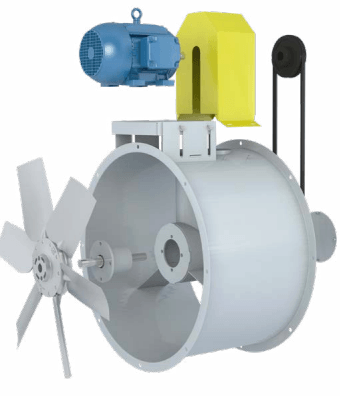
Axial fans operate by drawing air through the fan along the same direction as the shaft around which the blades rotate. They’re ideal for applications requiring high airflow at low static pressure.
Unlike centrifugal fans, which move air perpendicularly, axial fans push air straight through, making them perfect for linear ducting systems.
Use case: In industrial exhaust systems or underground parking ventilation, axial fans quickly remove stale air with minimal pressure drop.
At BromingHVAC, we manufacture and supply a wide variety of axial fans for different commercial and industrial applications.
Axial fans are used in various commercial and industrial environments:
| Application | Function |
|---|---|
| Duct Ventilation | Inline supply and exhaust air movement |
| Cooling Towers | Efficient air circulation over water |
| Parking Garages | High-volume smoke extraction |
| Warehouses | General ventilation & cooling |
| Cleanrooms & Labs | Assist airflow in pressure-controlled environments |
Tip: Pairing axial fans with BromingHVAC’s air ducts ensures efficient airflow with low pressure loss.

Step 1: Calculate Required CFM
CFM = Room Volume (ft³) × Air Changes per Hour ÷ 60
Example: 10,000 ft³ × 10 ACH ÷ 60 = 1,667 CFM
Step 2: Determine Static Pressure
Measure duct resistance, elbows, filters, etc.
Step 3: Use a Performance Curve
Download our CFM chart: Download PDF
Step 4: Confirm Voltage, Noise, Mounting Type
Common Mistakes:
| Feature | AC Axial Fans | EC Axial Fans |
|---|---|---|
| Energy Efficiency | Moderate | High ✅ |
| Speed Control | Limited | Precise ✅ |
| Noise Level | Higher | Lower ✅ |
| Cost | Lower ✅ | Higher (but efficient) |
| Application | General | Data centers, cleanrooms |
BromingHVAC is trusted by contractors and distributors across the Middle East and Southeast Asia. Here’s why:
Case Study: A UAE mall ventilation project reduced install time by 40% using Broming’s duct axial fans.
Explore Axial Fan Catalog

Axial fans are essential for modern HVAC systems. From airflow optimization to energy savings, BromingHVAC delivers complete fan solutions for your projects.