Need Specifications or a Quote?
Share your ventilation project requirements and our engineers will reply within 12 hours with technical specs, pricing, and lead time.



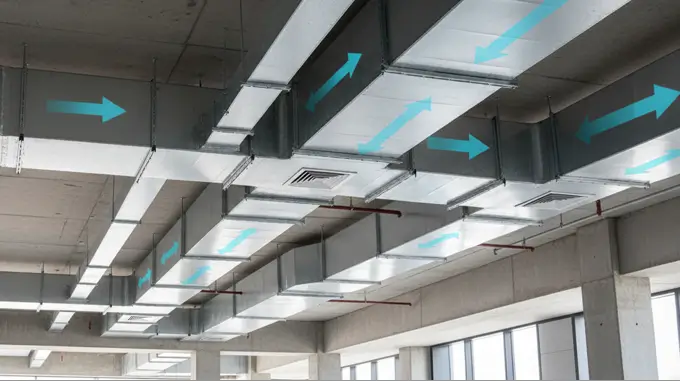
Efficient commercial air ducts are crucial to controlling energy consumption, occupant comfort, and indoor air quality (IAQ) in commercial buildings. Poorly designed or installed ductwork causes conditioned air loss through leakage and friction, forcing HVAC equipment to work harder and increasing energy costs. Conversely, properly designed, sealed, and balanced duct systems deliver the right air efficiently, reducing operating expenses and complaints.
This guide presents a practical framework for assessing, selecting, designing, installing, and commissioning commercial ductwork. It’s tailored for building owners, facility managers, and mechanical contractors who need straightforward, technical guidance to ensure energy-efficient HVAC ductwork.
HVAC systems often account for the largest energy use in commercial buildings, with ducts representing a major point of energy loss. Issues like leakage, high friction from undersized or complex runs, and imbalanced airflow increase fan power consumption and equipment runtime.[2][7] Efficient ducts—especially round sheet metal with smooth interiors and good insulation—reduce pressure drops, helping fans use less energy.[7]
Duct leaks waste heated or cooled air, raising costs. High static pressure stresses fans and shortens equipment life. Well-designed duct systems maintain airflow efficiently, reduce energy use, and sometimes allow smaller fan sizing.[2][7]
Comfort is also affected by duct design. Round and spiral ducts provide quieter, more uniform airflow than wide, flat rectangular ducts, improving acoustic conditions.[3][7] Correctly sized and placed supply and return ducts minimize temperature variation, drafts, and dead airflow zones, which can accumulate pollutants.[1]
Even the best duct design underperforms if installation is poor—joints that aren’t sealed well, over-bent or kinked flexible ducts, or sagging supports degrade airflow and increase noise.[5] Field changes can add elbows and long flexible runs, compromising efficiency.
Maintenance matters: dust, damaged insulation, and loosened connections worsen performance. Smooth metal ducts are easier to clean and maintain, supporting system efficiency and IAQ when inspected regularly.[1][7]
Together, efficient design, quality installation, and proactive maintenance reduce lifecycle energy use, noise, complaints, and rework risks.
Pro tip: Early coordination between trades and thorough field verification prevents costly duct reroutes that increase static pressure and energy use.
Duct needs vary widely by building type. Open warehouses and gyms often use exposed round or fabric ducts for wide, even airflow.[3][6] Partitioned offices and healthcare facilities require more branches and zoning to serve multiple small rooms effectively.
Building size and shape affect total airflow needs and duct routing complexity. Longer runs and multiple branches require careful static pressure management to ensure distant zones receive designed airflow without oversizing fans. Multi-story buildings add vertical risers to the equation.[3]
High-density spaces (classrooms, call centers) require increased outdoor air and ventilation, affecting duct sizing and branch design. Process-heavy areas (data centers, kitchens) have unique airflow demands.[3]
Building codes and ventilation standards specify minimum outdoor air and air change rates. Sensitive areas (labs, cleanrooms) need tighter sealing, separate duct runs, and materials resistant to microbes or chemicals.[8]
Physical constraints impact duct shape choices. Round ducts are most efficient but can be too tall for shallow plenums or crowded ceilings.[2][7]
Rectangular ducts fit better in tight spaces but may cause higher friction and noise if very wide and shallow.[5] Flat oval ducts are a compromise, maintaining some round duct efficiency while fitting lower spaces, but add fabrication complexity.[5]
Exposed ceilings open design options like spiral metal or fabric ducts, balancing aesthetics and airflow. Early coordination with structural and electrical work is essential for efficient layouts.[2][6]
| Duct Type | Space Efficiency | Noise Level | Airflow Efficiency | Installation Complexity |
|---|
| Round | Requires more vertical space | Low (quiet) | Highest; smooth interior reduces friction | Moderate; straightforward fittings |
| Rectangular | Fits tight plenums, low height | Higher noise potential | Lower due to edges and high aspect ratios if wide/shallow | Easier to fabricate and coordinate |
| Flat Oval | Good low-profile fit | Quieter than rectangular | Near-round efficiency | More complex fittings and transitions |
Round ducts minimize surface friction and noise,[2][3][7] ideal for main runs where height permits. Rectangular is common for congested plenum spaces despite slightly higher friction losses.[5] Flat oval ducts balance profile height and efficiency but increase fabrication cost and onsite adjustment complexity.[5]
Round and spiral ducts suit large open areas (warehouses, gyms).[2][3] Rectangular ducts are prevalent in offices, schools, and hospitals, often transitioning to round branches.[3][7] Flat oval ducts work well in retrofits or areas with ceiling height constraints.[5]
Flexible duct connects rigid mains to diffusers, valued for its ease of routing and cost efficiency.[3][5] However, it has higher internal resistance; kinks, sags, and bends degrade airflow and increase energy use.[5] Flex ducts are also vulnerable to dust buildup and damage, complicating cleaning.[5]
Guidelines limit flex duct to short, straight runs typically a few meters/feet[3][5] with tight support spacing to avoid sagging. Sharp bends and heavy compression are avoided to preserve airflow.[5]
Field note: Overusing flexible duct as a substitute for rigid runs is a common mistake that increases pressure drop and fan energy.
Galvanized steel is standard for strength, rigidity, and smooth interiors that reduce friction and dust accumulation.[1][7] It withstands higher pressures and mechanical impact, making it ideal for mains.[1]
Aluminum is lighter and corrosion resistant but costlier, suitable in weight-sensitive or mildly corrosive environments.[1][9]
Fabric ducts are increasingly popular for industrial and commercial use due to low weight, uniform air distribution, low noise, and resistance to dust and microbial growth. Their integrated insulation can improve thermal control and IAQ.[6]
Corrosive or humid spaces require materials such as stainless steel, coated metals, corrosion-resistant aluminum, or fabric ducts designed for washdown and microbial resistance.[5][6][9]
Airflow is measured in cubic feet per minute (CFM), representing volume delivered to spaces. Ducts must deliver target CFM with minimal friction loss—expressed in inches water gauge (in. w.g.) per 100 feet.
For example, at 1,500 CFM, a 14-inch round duct may see ~0.20 in. w.g. pressure drop per 100 ft; increasing to 5,000 CFM requires a 22-inch duct to keep similar friction levels.[4]
Optimal friction targets typically range 0.08–0.2 in. w.g. per 100 ft.[4][8] Undersizing raises static pressure and fan energy; oversizing reduces friction but adds cost and can cause low velocity issues.
Total airflow links to equipment capacity, commonly estimated in CFM per ton of cooling.[3] Building size, occupancy, and usage refine total airflow and zoning.
Duct calculators and friction charts assist sizing, but final design should come from qualified engineers using proper load calculations.[4][5]
Non-engineers should ensure that:
Each elbow or transition adds turbulence and friction, raising fan energy and noise.[1][3][4][5][6] Keeping mains straight and using smooth-radius elbows reduces losses.
Early coordination can enable more direct routes and avoid inefficient reroutes.[1]
Rectangular ducts perform better with aspect ratios closer to square.[5] Wide, flat ducts increase friction and noise unless well braced.
Transitions between duct sizes/shapes should be gradual to maintain smooth airflow and reduce pressure drop.[5] Flexible duct connections must be short, taut, and aligned properly.
Successful installation starts with thorough document review and site verification of structural conditions versus design. Coordination with electrical, plumbing, fire protection, and ceiling trades prevents conflicts in crowded plenums.[1][6]
Confirm fire damper, access door, and test port locations remain accessible during and after construction.[1]
1. Mark hanger locations based on duct size and material.
2. Install hangers and supports, ensuring spacing prevents sagging.
3. Set and join main duct sections tightly and seal joints properly.
4. Install branch takeoffs at specified angles, avoiding abrupt turns.
5. Route branch ducts shortest and straightest possible.
6. Install access panels, fire dampers, and balancing dampers correctly.
7. Keep ducts capped during installation to maintain cleanliness.
Branch takeoff sizing and routing affect airflow balance; poorly executed connections increase pressure losses and complicate commissioning.[6][9]
Sealing joints with mastics, gaskets, or approved tapes reduces duct leakage, improving efficiency and compliance.[5][8] Pay special attention where ducts join equipment and access doors.
Insulation controls heat loss/gain and condensation on ducts through unconditioned spaces. Appropriate R-values and vapor barriers are essential for humid climates.[5]
Supports must prevent sagging, crucial for flexible duct. Wide straps that cradle ducts maintain shape and airflow better than narrow hangers.[5]
Common mistake: Neglecting duct sealing and insulation leads to energy loss and costly rework later in the building lifecycle.
Leakage testing pressurizes duct sections to measure losses against standards.[5][8] Limits on leakage improve efficiency and comfort, particularly for outdoor air systems.
Airflow tests at diffusers confirm delivered CFM versus design values, uncovering blockages or sizing errors. Fan speed, system airflow, and static pressures are verified during commissioning.[8]
Air balancing adjusts dampers and fans to deliver design airflow evenly, preventing over- or under-conditioned zones. Balanced systems reduce energy use, noise, and drafts, improving occupant comfort and maintaining pressure relationships, vital in sensitive spaces.[8]
Facility managers should obtain:
This documentation supports future maintenance and performance verification.
Commissioning checklist example
– Verify duct tightness within specified leakage class.
– Confirm measured airflow matches design per zone.
– Document damper adjustments and final positions.
– Provide report of any field changes from design.
Costs vary by complexity but typically range from $6,000 to over $30,000, equating to $15–$30 per square foot of serviced area.[3] Higher-efficiency duct systems using round/flat oval ducts, better sealing, and improved insulation increase upfront cost but pay off via lower energy bills and fewer comfort complaints.
Reducing friction and leakage directly lowers fan power needs.[2][8] For example, maintaining friction losses in the recommended 0.08–0.2 in. w.g. per 100 ft range avoids oversizing fans, saving substantial energy.[4][8]
Good design also boosts temperature uniformity and reduces noise, cuttings service calls and tenant complaints.[2][3]
Efficient systems require ongoing inspections and cleaning:

Complex projects—healthcare, labs, data centers—benefit from expert mechanical engineering for rigorous load and duct design, including friction analysis and alternative materials evaluation.[6]
Commissioning agents or third-party TAB firms validate installation through testing and balancing, reducing risk and costly rework.
Commercial air ducts commonly include round, rectangular, flat oval, and flexible ducts. Round ducts are most efficient for airflow, rectangular ducts fit tight spaces better, flat oval ducts balance efficiency and reduced height, and flexible ducts are used mainly for short branch connections.[2][3][5]
Proper installation involves pre-planning and coordination, installing correctly spaced supports, sealing joints thoroughly, routing ducts to minimize bends and length, and ensuring access doors and fire dampers are accessible. Avoid sagging flexible ducts and maintain cleanliness during installation.[1][5][6]
Galvanized steel is standard for strength and airflow efficiency. Aluminum is lighter and corrosion resistant but costlier. Fabric ducts offer low weight, uniform airflow, and microbial resistance, suitable for specialized needs. Material choice depends on environment and maintenance considerations.[1][6][9]
Regular inspections should be scheduled to check for leaks, damaged insulation, and loose connections. Environments prone to dust or microbial growth may require more frequent cleaning. Periodic re-commissioning after building changes is advisable to maintain efficiency.[1][6][7]
Fabric air ducts weigh less, provide diffuse, quiet airflow, and resist dust accumulation and microbial growth. They often reduce maintenance needs and improve IAQ, helping sustain energy-efficient operations, especially in moist or sensitive environments.[6]
Source
Commercial duct types and efficiency | HVAC ductwork installation guide | Commercial HVAC duct sizing