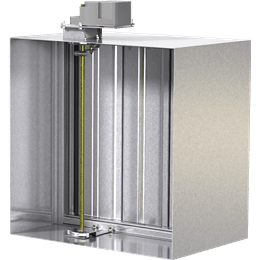
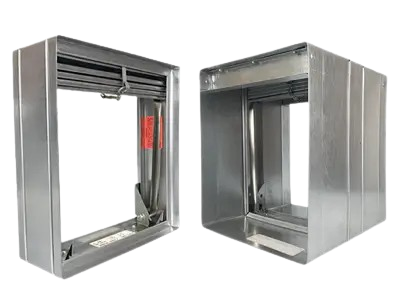
Fire and smoke dampers are critical life-safety devices installed in HVAC ducts and openings within fire-rated walls, floors, shafts, and partitions. Their purpose is to contain fire and smoke, maintaining the integrity of fire-resistance–rated assemblies.[3][6]. Required by building and fire codes in commercial, institutional, healthcare, and industrial projects, they serve as a vital interface between mechanical systems and passive fire protection.[3][6]
Fire dampers close automatically during a fire to block flames and hot gases from spreading through duct penetrations. Smoke dampers restrict smoke movement in ducts and air transfer openings within smoke barriers or partitions, often as part of smoke control systems.[4][6] Combination fire/smoke dampers perform both functions in one assembly.[3][5]
For buyers, the challenge is selecting, installing, and maintaining the right dampers to ensure inspection success, ongoing code compliance, and to avoid costly rework or operational disruptions.
What Are Fire, Smoke, and Combination Dampers?
Fire Dampers: Installed where ducts and air openings penetrate fire-resistant assemblies; tested to UL 555 to resist flames for 1½ or 3 hours. A heat-responsive element triggers blade or curtain closure upon fire detection.[3][4][7]
Smoke Dampers: Installed in smoke barriers or partitions to limit smoke spread; tested to UL 555S for leakage and operation at elevated temperatures under airflow and pressure. Typically motorized and controlled by fire alarm or smoke control systems.[4][5][10]
Combination Fire/Smoke Dampers: Meet both UL 555 and UL 555S standards, combining fire resistance and smoke control features, often favored in shafts and risers where both hazards exist.[3][4][5]
Why Fire and Smoke Dampers Matter for Life Safety and Code Compliance
Smoke inhalation causes more fire-related injuries and deaths than flames. Uncontrolled smoke can block egress routes and refuge areas.[4][10] Dampers compartmentalize fire and smoke, buying critical evacuation and firefighting time.[6]
Codes like the International Building Code (IBC), International Mechanical Code (IMC), and NFPA standards mandate dampers in specific locations. Omitting or incorrectly installing dampers risks failed inspections, loss of occupancy certificates, and liability.[3][6][8][10]
Properly specified and installed dampers protect occupants and projects, ensuring compliance and avoiding costly corrective actions.[8][10]
Overview of Buyer’s Guide Objectives
This guide helps you navigate the full lifecycle of fire and smoke damper decisions:
Identify requirements for fire-only, smoke-only, or combination dampers.[4][6]
Understand key codes and standards on practical terms (IBC, NFPA, UL).[3][5][6]
Evaluate damper ratings, leakage classes, velocity/pressure, construction, and actuators.[2][5][6]
Recognize installation requirements and frequent mistakes causing inspection failures.[5][6][8]
Plan inspection, testing, and maintenance for ongoing compliance.[5][8][10]
Use checklists and decision questions to coordinate with suppliers, contractors, and AHJs.
Understanding Codes, Standards, and Ratings
Key Codes Governing Dampers (IBC, NFPA, UL)
Fire and smoke dampers must comply with intersecting model building codes, NFPA standards, and product test standards:
Code / Standard
Scope
IBC & IMC
Define damper locations and reference UL/NFPA for performance and installation.
NFPA 80
Fire damper installation, inspection, testing, and maintenance in fire-rated assemblies.
NFPA 90A
Requires fire and smoke dampers in HVAC ducts, with specific installation provisions.
NFPA 101
Life Safety Code that references damper requirements through other applicable codes.
NFPA 105
Installation and periodic testing requirements for smoke and combination dampers.
UL 555
Fire damper fire-resistance and performance testing standards.
UL 555S
Smoke damper leakage classification and elevated-temperature operational testing.
Local jurisdictions may require specific code editions; always verify with the AHJ.
Fire Resistance Ratings and Their Applications
Fire and combination dampers are generally rated for 1½ hours or 3 hours according to the fire-resistance rating of the barrier penetrated.[5][7]
UL 555 requires fire dampers to withstand time-temperature exposure and hose-stream tests; dynamic fire dampers must also close under rated airflow and pressure.[4][5][6]
Buyers must know:
The hourly fire-resistance rating of each barrier penetrated.
The code-required damper rating matching the barrier’s rating.
Whether a static (no airflow) or dynamic (with airflow) damper is needed.[2][5][6]
Leakage Classes and Velocity/Pressure Ratings Explained
Smoke and combination dampers have leakage classes under UL 555S — Class I (lowest leakage), II, or III — determining maximum air leakage under pressure and temperature.[5][8]
Velocity (feet per minute) and pressure (inches water gauge) ratings indicate damper operation limits at airflow and pressure during fire or smoke events.[2][5][6]
Failure to select dampers with appropriate leakage and pressure ratings risks improper closure, smoke migration, and code violations.[5][6][8]
Practical Implications of Codes When Specifying Dampers
Specification must consider:
Barrier type: fire barrier, smoke barrier, shaft, or corridor, and associated fire-resistance rating.[3][6]
Match damper type and rating accordingly (fire, smoke, combination).[4][6]
HVAC system operation during fires: shutdown fan (static dampers) or continue running (dynamic dampers).[2][3][6]
Required leakage class and velocity/pressure ratings based on smoke control system design.[4][5][8]
UL listing confirmation and adherence to manufacturer installation instructions.[5][6]
This reduces disputes and late-stage changes from AHJs.
Types of Dampers and Typical Applications
Fire-only, Smoke-only, and Combination Fire/Smoke Dampers
Fire Dampers: Protect fire-rated walls, floors, and shafts from fire spread via ducts; not smoke leakage-rated unless combination units.[3][6][9]
Smoke Dampers: Installed in smoke barriers and control systems to restrict smoke migration; leakage-rated per UL 555S.[4][6][10]
Combination Dampers: Used in penetrations requiring both fire and smoke control, such as smoke-rated shafts with fire resistance; simplify system coordination.[4][5]
Static vs Dynamic Fire Dampers and Their Uses
Damper Type
System Operation
Testing & Ratings
Typical Use Cases
Static
HVAC fans shut down during a fire event
Tested under no-airflow conditions (UL 555 only)
Systems where fan shutdown occurs; damper closure without airflow.
Dynamic
HVAC system continues operating during a fire event
Tested to close under specified airflow velocity and pressure (UL 555)
Smoke control, stair pressurization, and systems designed to run during fire conditions.
Selection depends on HVAC fire response and code requirements.[2][3][6]
Differences Between Rectangular, Round, and Corridor Dampers
Rectangular Dampers: Common for rectangular ducts and wall/floor openings; curtain or multiple-blade types; used in main trunks and large penetrations.[5]
Round Dampers: Fit round ducts; simple to retrofit; some models rated for higher velocities (~4,000 fpm at 4 in w.g.).[5][9]
Corridor Dampers: Designed for fire-rated corridor walls to allow air transfer while maintaining fire integrity; have specific listings and installation rules.[6]
Ceiling radiation dampers exist but are beyond this guide’s scope.
Common Installation Locations with Diagrams
Typical installation points include:
Duct penetrations through fire barriers between areas or occupancies.
Openings in fire-resistance–rated corridor walls and smoke barriers.
Penetrations into vertical shafts (stairwells, elevator shafts, mechanical shafts).
Penetrations of smoke partitions involved in smoke control.
Floor/ceiling assemblies between stories.
Manufacturers’ catalogs and code commentaries provide detailed installation diagrams crucial for coordination during design and installation.[5][6]
Field note: Installing dampers accurately within fire and smoke barriers, respecting sleeve and clearance requirements, is key to passing inspections. Misplacement or unapproved mounting often leads to costly rework.
Step-by-Step Buyer’s Checklist for Selecting Dampers
Identify Barrier Rating and Required Fire Rating
Review drawings to determine barrier type and fire resistance (e.g., 1, 2, 3 hours).
Align damper fire rating accordingly (1½-hour damper for barriers ≤2 hours; 3-hour damper for ≥3 hours).[3][5][7]
Coordinate with AHJ on deviations or performance-based designs.
Determine Fire, Smoke, or Combination Damper Needs
Fire damper required at fire barriers, partitions, shafts unless exceptions apply.
Smoke damper required at smoke barriers, partitions, or smoke control system ducts.
Combination dampers used where both fire and smoke separation required.[3][4][6]
Document requirements carefully using project codes and mechanical schedules.
Choose Between Static and Dynamic Fire Dampers
If HVAC fans shut down on fire, static dampers suffice.
If fans continue (smoke control or pressurization), dynamic dampers required.
Confirm local code or AHJ mandates on damper type.[2][3][6]
Select Size, Shape, and Mounting Configuration
Match damper size and shape to duct/opening dimensions within the barrier plane.
Rectangular for rectangular ducts; round for round ducts; check listing for permitted installation orientation.
Specify mounting orientation (vertical/horizontal), wall or floor installation, and sleeve details per UL listing.[5][6]
Choose Leakage Class, Velocity, and Pressure Ratings
Select leakage class (Class I or II preferred) based on smoke control needs.[5][8]
Verify airflow velocity and pressure ratings meet or exceed system design conditions.
Dynamic fire dampers should meet or exceed 2,000 fpm and 4 in w.g.[5][6]
Evaluate Actuator Compatibility and Features
Confirm actuator torque matches damper size and blade design.
Match voltage and control type to building automation/fire alarm systems.[1][5]
Prefer spring-return actuators for fail-safe operation.
Ensure UL/ETL listing for elevated temperature rating.
Consider actuators with end switches or position feedback for monitoring.[1][2][5]
Verify UL Listing and Installation Documentation
Fire dampers: UL 555 listing with appropriate fire rating and static/dynamic classification.
Smoke dampers: UL 555S listing with leakage class and operational ratings.
Combination dampers: Listed to both UL 555 and UL 555S.
Obtain and review manufacturer installation instructions; incorporate into construction documents.[5][6]
Printable Buyer’s Checklist and Decision Tree
Step
Key Questions
Decision Notes
Barrier Type & Fire Rating
What is the fire-resistance rating of the barrier?
Select a 1.5-hour or 3-hour rated damper as required.
Damper Function
Is a fire, smoke, or combination damper required?
Confirm based on building use and applicable code requirements.
Static vs. Dynamic
Will the HVAC system shut down upon fire alarm?
Choose static or dynamic damper accordingly.
Size and Shape
What are the duct and opening dimensions?
Rectangular, round, or corridor damper configuration.
Leakage & Pressure Ratings
What leakage class and velocity/pressure ratings are required?
UL ratings must meet or exceed the system design loads.
Actuator Type
What torque, voltage, fail-safe, and monitoring functions are required?
Verify actuator compatibility and certifications.
UL Listing
Does the product carry the correct UL listings?
Confirm listings for all applicable standards (e.g., UL 555, UL 555S).
Pro tip: Use this checklist early in design to communicate clearly with contractors and AHJs and avoid expensive late-stage changes.
Calculation logic overview for damper selection Input: Barrier fire rating, HVAC system type, duct size and shape, smoke control needs Process: 1. Match damper fire rating to barrier rating 2. Determine if fire-only, smoke-only, or combination damper needed 3. Identify system operation during fire (static/dynamic) 4. Select damper size and shape matching duct/opening 5. Verify leakage class and velocity/pressure ratings fit system requirements 6. Choose compatible actuator features Output: Specification-ready damper model and installation instructions
Installation Requirements and Avoiding Common Mistakes
Key Installation Rules and Guidelines
Install dampers so blades and frame are within the plane of the fire/smoke barrier or allowed offsets per listing.
Use UL-listed sleeves with proper gauge, length, and retaining angles or flanges on both sides of the barrier.
Maintain clearances specified in listings for expansion and integrity; use only approved sealants or materials.
Install dampers only in orientations approved by UL listing (vertical, horizontal, or both).
Provide access doors for inspection, testing, and maintenance in ducts or adjacent construction.
Frequent Installation Errors Leading to Inspection Failures
Missing or incorrect dampers due to misinterpreting drawings or code.[6][8]
Incorrect mounting: omitted sleeves/retaining angles or unapproved fasteners.[5][6]
Improper clearances (too wide/narrow) or unapproved materials obstructing damper function.[5][8]
Obstructed blades or linkages from duct transitions or debris.[5][8]
Inadequate or misplaced access for inspection/testing.[8][10]
Incorrect actuator wiring or control leading to non-operation during tests.[4][8][10]
Importance of Following UL-Approved Installation Instructions
UL listings are based on tested assembly configurations. Deviations may compromise damper performance and cause AHJ rejection. Strict adherence to manufacturer instructions during installation:
Ensures dampers perform as tested.
Supports permitting and inspection success.
Reduces liability by installing to tested conditions.[5][6]
Field note: Noncompliance with UL installation often results in costly and time-consuming rework; always review instructions during submittal and pre-installation meetings.
Inspection, Testing, and Maintenance Guidelines
NFPA Requirements for Testing Frequency and Documentation
Initial testing after installation to confirm full closure and no damage.
Periodic testing at designated intervals (e.g., every 4 years generally, every 6 years in hospitals).[5][8][10]
Maintain detailed records of damper ID, location, test date, deficiencies, and corrective actions.
Typical Inspection Failures and Prevention Strategies
Common issues include:
Blades failing to close fully due to paint, corrosion, or debris.
Painted or corroded fusible links or non-listed replacements.
Faulty actuators from wiring errors or mechanical binding.
Duct obstructions blocking movement.
Concealed or inaccessible access doors.
Prevention:
Specify corrosion-resistant materials and quality actuators.[5][8]
Ensure adequate, accessible inspection openings.
Include dampers in routine maintenance with qualified personnel.
Keep clear documentation of all inspections and repairs.[8][10]
Role of Actuators and End Switches in Maintenance
Select actuators rated for high cycle life and elevated temperature reliability.[1][2]
Auxiliary switches enable remote monitoring via BMS, simplifying tests and troubleshooting.
Label all damper and actuator locations clearly with control diagrams.
Damper commissioning and balancing workflow For each damper location: 1. Verify installation per UL instructions 2. Test manual and automatic closure (fusible link / actuator) 3. Confirm actuator control wiring and fail-safe function 4. Record results and note any deficiencies 5. Clear duct obstructions and verify blade freedom 6. Schedule recurring inspection intervals
Evaluating Cost, Risk, and Choosing the Right Supplier
Assessing Total Cost of Ownership and Risk of Non-Compliance
Consider more than product price:
Installation labor and required access provisions.
Testing, inspection, and maintenance costs over the lifecycle.
Costs and schedule impacts of failed inspections or non-compliance shutdowns.[8][10]
Liability risks including fines and insurance exposure.
Quality dampers with robust construction and documented compliance may have higher upfront cost but reduce long-term expenses and operational interruptions.[2][5][8]
Supplier Evaluation Criteria: Certifications, Warranty, and Support
Verify UL 555 and/or UL 555S listings with full documentation for AHJs.[4][5]
Ensure availability of submittals, installation instructions, BIM/Revit files, and O&M manuals.[5][10]
Assess warranty terms and supplier track record.
Confirm reliable lead times and logistics to avoid project delays.
Key Questions to Ask Vendors Before Purchase
What UL standards apply to the damper models? Can you provide listing cards and test reports?[4][5]
What fire-resistance, leakage class, and velocity/pressure ratings are valid for my sizes?[5][6]
How are actuators selected and listed for this application and temperature range?[1][5]
What are the permitted installation conditions (wall/floor types, sleeves, orientations)?[5][6]
What warranty and technical support services are offered, including post-installation assistance?[2][5][10]
Real-World Examples and Case Studies
Hospital Smoke Control Zones with Combination Dampers
Hospitals require strict smoke compartmentation and fire separation. Combination dampers rated Class I leakage are standard in shafts and smoke barriers connected to dedicated smoke control systems. Integrated with fire alarm systems, dampers close or open per smoke control sequences, ensuring patient safety.[4][6] These units include spring-return actuators and position feedback for continuous monitoring.[1][5]
Office Building Corridors Using Corridor Dampers
Fire-rated corridor walls often require corridor dampers, which maintain fire integrity while allowing required air transfer. Proper access doors are provided on the corridor side. Using standard fire dampers or omitting access in these applications leads to inspection failures and potential rework.[6][8]
Retrofit Projects and Installation Challenges
Upgrading smoke compartmentation in existing buildings often involves adding dampers in tight spaces or existing ducts. Round combination dampers are useful in retrofit shafts with limited space. Careful adherence to manufacturer retrofit instructions and proper sleeve installation are critical to avoid costly demolition or rework.[5][9]
Conclusion and Next Steps
Recap of Key Decision Points
Identify barrier type and fire-resistance rating.
Define required damper function: fire, smoke, or combination.
Select static or dynamic damper based on HVAC fire response.
Choose correct size, shape, and mounting per duct and opening.
Specify fire rating, leakage class, and velocity/pressure performance.
Ensure actuator compatibility with fail-safe and monitoring features.
Verify UL listings and follow manufacturer installation instructions.
Implement routine inspection, testing, and maintenance.
Calls to Action: Download Checklist, Request Spec Review, Contact Experts
Develop or download a fire and smoke damper buyer’s checklist for project review.
Engage fire protection or mechanical engineers for complex projects or smoke control integration.[3][6]
Consult manufacturers early in design for product applicability and installation guidance to avoid costly changes.[2][5][10]
Key takeaways for ensuring code compliance and optimal damper selection
Use UL-listed dampers matching barrier rating and required function.[4][5][6]
Align damper type with HVAC system operation during fire events.[2][4][6]
Specify leakage and airflow ratings that meet system conditions to ensure reliable performance.[5][8]
Enforce proper installation per UL-upheld details with adequate inspection access.[5][6][8]
Include dampers in life-safety maintenance plans with thorough testing documentation.[5][8][10]
Appendix: Glossary and Additional Resources
Term
Definition
Fire Damper
A device installed in fire-rated assemblies to restrict the spread of fire; tested in accordance with UL 555.
Smoke Damper
A device installed in smoke barriers to restrict smoke movement; tested in accordance with UL 555S.
Combination Fire/Smoke Damper
A damper listed to both UL 555 and UL 555S, providing fire resistance and smoke control in a single assembly.
Static Fire Damper
A fire damper designed to close without airflow; used where HVAC fans shut down during a fire event.
Dynamic Fire Damper
A fire damper tested to close against specified airflow velocity and pressure; used where HVAC systems continue operating during a fire event.
Leakage Class
An air leakage rating (Class I–III) defined under UL 555S, specifying allowable leakage limits at stated pressure differentials.
Velocity / Pressure Rating
The maximum airflow velocity and pressure at which a damper is rated to close and maintain its position.
Actuator
A motorized device that controls damper blade movement, commonly spring-return and equipped with end switches for status indication.
Fusible Link
A temperature-sensitive element that releases and triggers fire damper closure when a specified temperature is reached.
Additional resources:
Model codes: IBC, IMC, NFPA 80, 90A, 101, 105, 5000.
Product standards: UL 555 (Fire Dampers), UL 555S (Smoke Dampers).[4][5]
Manufacturer and industry guides offering detailed selection charts and installation instructions.[2][5][6]
FAQ
What is the difference between fire dampers and smoke dampers?
Fire dampers prevent the spread of fire and hot gases through duct penetrations by closing during fire conditions, tested to UL 555. Smoke dampers restrict smoke movement through ducts in smoke barriers, tested under UL 555S for leakage and operation at elevated temperatures.[3][4][5]
When are combination fire smoke dampers required?
Combination dampers are specified where both fire resistance and smoke control are needed at the same penetration, such as smoke-rated shafts that are also fire-resistance rated. They combine both UL 555 and UL 555S certifications.[3][4][5]
How are fire smoke dampers tested and certified?
Fire dampers are tested to UL 555 for fire-resistance and operation under fire exposure. Smoke dampers and combination units are tested to UL 555S for leakage and operation at elevated temperatures with airflow and pressure conditions.[4][5]
What are the installation requirements for fire and smoke dampers?
Dampers must be installed within the plane of the rated barrier per UL listing, with approved sleeves, retaining angles, correct clearances, orientation, and accessible inspection openings. Adhering strictly to manufacturer instructions is mandatory.[5][6]
How often should fire and smoke dampers be inspected?
Initial testing after installation is required, followed by periodic inspections typically every 4 years, or every 6 years in certain occupancies like hospitals, per NFPA 80 and NFPA 105 standards.[5][8][10]
Can fire and smoke dampers be used interchangeably?
No. Fire dampers are rated for fire exposure only; smoke dampers control smoke migration with leakage ratings. Combination dampers cover both but must be specified based on code and application requirements.[3][4][5]
What codes govern fire and smoke damper installation?
Primary codes include the International Building Code (IBC), International Mechanical Code (IMC), NFPA 80, NFPA 90A, NFPA 101, NFPA 105, along with UL 555 and UL 555S product standards.[3][5][6]