Need Specifications or a Quote?
Share your ventilation project requirements and our engineers will reply within 12 hours with technical specs, pricing, and lead time.


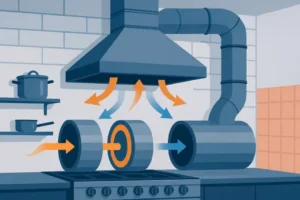
Did you know that poorly designed HVAC kitchen ventilation systems can lead to inefficient airflow, excessive heat, and even non-compliance with health regulations? In commercial kitchens, where high-temperature cooking produces significant heat and smoke, an effective ventilation system isn’t just a luxury—it’s essential for safety, comfort, and operational success.
Whether you’re running a restaurant or designing kitchens for food service establishments, understanding the intricacies of HVAC kitchen ventilation is crucial. From managing kitchen airflow to controlling heat and maintaining compliance with strict codes, every detail plays a critical role in creating an efficient and safe environment.
In this article, we’ll explore how to design optimal kitchen HVAC systems, navigate compliance requirements, and implement best practices for long-term performance. You’ll gain actionable insights to improve airflow management and reduce common issues in even the busiest commercial kitchens, setting the foundation for a more productive and compliant workspace.
HVAC kitchen ventilation systems are key to maintaining safe, efficient, and compliant commercial kitchens. Below are expert insights to guide effective design and integration practices.
These best practices highlight how advanced design and technology enhance airflow, compliance, and safety in commercial kitchens. Dive deeper to learn actionable strategies for implementing them effectively.
This guide is written for HVAC engineers, building designers, and commercial kitchen operators who are responsible for specifying, designing, and operating commercial kitchen ventilation systems. These stakeholders are typically dealing with dense, high-heat cooking environments where airflow, pressure control, and code compliance must be managed with much tighter tolerances than in typical comfort-cooling projects.
HVAC engineers and consulting designers need a focused resource because HVAC kitchen ventilation is governed by specialized standards, unique contaminant loads, and non-linear interactions between exhaust, make-up air, and building pressure. Their priorities include correctly sizing exhaust and supply systems, maintaining capture at hoods under variable cooking loads, and integrating these systems with wider building HVAC without compromising comfort in dining or adjacent spaces.
Architects and building designers require clear guidance on spatial and routing implications of kitchen HVAC design. Duct sizes, shaft locations, rooftop equipment, and clearances around grease ducts all compete with other building services and structural constraints. Early understanding of ventilation requirements helps prevent costly redesigns and ensures that fire, access, and maintenance clearances can be met within the architectural layout.
Commercial kitchen operators focus on reliability, safety, and operating cost. They need to maintain acceptable working conditions in high-activity kitchens, ensure restaurant HVAC systems compliance, and avoid issues such as smoke spill, odors in dining areas, or excessive negative pressure. At the same time, they are under pressure to limit energy consumption and downtime, so they benefit from clear criteria to evaluate existing systems and to understand the impact of control strategies and maintenance practices.
This guide is structured to support decision-making at each of these roles. It interprets technical standards into design and operating implications, clarifies how to select and integrate components, and highlights how advanced automation and airflow balancing can resolve chronic issues. It also provides a framework for ongoing maintenance, troubleshooting, and system upgrades, leading naturally into more detailed engineering and design guidance in subsequent sections.
The content that follows is a technical resource focused specifically on HVAC kitchen ventilation in commercial environments. It does not address residential kitchens, generic building HVAC, or comfort-only cooling topics. Instead, it concentrates on the high-load, contaminant-rich conditions found in restaurant, hotel, institutional, and production kitchens, where exhaust and make-up air systems are critical safety infrastructure.
The guide covers the full lifecycle of HVAC systems for restaurants and similar facilities: design, specification, installation, operation, and optimization. It emphasizes how to balance exhaust and supply air, manage pressure differentials (ΔP) between kitchen and adjacent spaces, and maintain capture and containment at hoods under varying cooking activity. Concepts such as duct velocity, hood overhang, and air changes per hour are tied directly to practical layout and component decisions.
A core theme is the integration of airflow control strategies and automation. Advanced approaches include variable-speed fans with VFDs, demand-controlled ventilation using temperature or effluent sensors, and system-level logic to keep ΔP and capture performance within defined limits throughout the day. These approaches are particularly important in high-activity kitchens where loads fluctuate significantly between prep, service peaks, and idle periods, and where energy costs can be dominated by ventilation.
Equally important is what this guide does not focus on. It does not provide promotional or marketing content and does not attempt to sell specific products. Comfort-only topics such as generic office HVAC layouts, residential zoning, or simple split-system selection are only referenced when they affect kitchen performance. Readers seeking a broader foundation on comfort HVAC can refer to Explore HVAC fundamentals for commercial spaces., while this guide remains centered on critical exhaust and make-up air functions in kitchens.
Engineering value is prioritized through actionable design advice, clear explanations of NFPA, ASHRAE, and SMACNA requirements, and practical insights into the best ventilation solutions for high-activity kitchens. With that positioning established, the next sections break down the core technical concepts and performance metrics that govern effective commercial kitchen ventilation.
Effective HVAC kitchen ventilation is governed by a small set of measurable parameters that define whether a system can contain heat, smoke, and grease-laden vapors while maintaining acceptable comfort. Understanding these metrics is essential for both design and diagnostics.
Exhaust and supply air volume (CFM) is the primary sizing parameter. Exhaust CFM must be sufficient to capture effluent generated at the hood, with typical values derived from hood length, duty rating of appliances, and capture efficiency assumptions. Supply or make-up air CFM is selected to replace a defined fraction of the exhaust while maintaining a slightly negative pressure in the kitchen relative to dining and circulation areas.
Air velocity plays different roles in ducts and at hood capture zones. In ducts, velocity must be high enough to transport grease aerosols and prevent deposition, but not so high that it causes excessive noise, pressure drop, or erosion. At the hood face, capture velocity must overcome convective plumes from hot appliances; inadequate capture velocity leads to smoke and heat spill, even if total exhaust CFM appears sufficient on paper.
The pressure differential (ΔP) between kitchen, dining areas, and outdoors is critical for containment and comfort. A modest negative pressure in the kitchen (often on the order of 0.02–0.05 in. w.g. relative to adjacent spaces) helps prevent odors and effluent from leaking out. However, excessive negative pressure can draw in unconditioned air through doors and infiltration paths, increasing load on the comfort system and creating door-opening issues.
Temperature control is addressed by considering sensible and latent loads from cooking, infiltration, and occupancy, as well as air changes per hour (ACH) in the kitchen space. High ACH can dilute heat and contaminants but at increased energy cost. Zoning temperature control between cooking lines, prep areas, and dishwashing spaces is often necessary due to distinct heat and moisture profiles.
These metrics are increasingly maintained by automation. Sensors monitoring temperature, hood effluent, and static pressure can modulate fan speeds via VFDs to maintain target CFM, ΔP, and capture performance. In high-activity kitchens, demand-controlled ventilation often yields 20–40% fan energy savings while stabilizing pressure relationships and reducing noise during off-peak hours, setting the stage for more sophisticated design strategies.
Commercial kitchens present a combination of thermal, spatial, and operational constraints that strongly influence kitchen HVAC design. The concentration of high-heat equipment such as fryers, charbroilers, ovens, and wok ranges creates intense convective and radiant heat plumes. These must be captured at the source; otherwise, local temperatures quickly become unacceptable, and contaminants spread throughout the building.
Grease and smoke accumulation is a central concern. Grease-laden vapors can deposit within hoods, ducts, and fans, raising fire risk and increasing pressure loss over time. Systems must be designed not only to meet initial performance targets but also to remain cleanable and maintainable, with adequate access doors, smooth duct interiors, and appropriate filtration stages.
Space limitations are common, especially in retrofits and compact restaurant layouts. Routing large, fire-rated grease ducts to the exterior or roof often competes with structure, plumbing, and other services. Designers must balance ideal duct geometry with real-world constraints, sometimes requiring offsets or vertical shafts. These constraints increase the importance of careful calculation of pressure losses and selection of fans that can accommodate higher static pressure while maintaining required CFM.
Noise is another constraint, especially where kitchens are open to dining areas. Excessive velocity in ducts, undersized silencers, or poorly isolated fans can transmit noise and vibration into occupied spaces. For engineers asking how to design HVAC systems for commercial kitchens that remain safe and maintainable over their lifecycle, noise control must be considered alongside fire safety and access for inspection and cleaning, leading directly into the need to align designs with applicable standards.
Restaurant HVAC systems compliance is anchored in several key standards and codes that define minimum acceptable practices. Understanding their practical impact is essential for both new designs and retrofits.
ASHRAE 154 provides guidance on ventilation for commercial cooking operations, including hood exhaust rates, capture and containment criteria, and make-up air strategies. It offers recommended CFM per linear foot of hood based on appliance duty class, as well as considerations for short-circuit and proximity hoods.
NFPA 96 governs the design, installation, operation, and maintenance of exhaust systems for commercial cooking equipment. It addresses hood construction, grease duct design, fire suppression, clearances to combustibles, and requirements for access doors and cleaning. Compliance affects the size and routing of ducts, the selection of fire-rated enclosures, and the integration of fire suppression tie-ins with ventilation controls.
SMACNA guidelines inform duct fabrication, support, and leakage control. For grease ducts, they support the use of fully welded or otherwise sealed metal ducts, appropriate gauges, and proper hangers and supports to prevent sagging and leakage. High-quality sheet metal work reduces pressure losses and improves safety. For example, many systems rely on Sheet metal duct materials for durability and hygiene. to meet both NFPA and SMACNA requirements.
In food processing or high-hygiene environments, ISO cleanliness levels and local food safety regulations may dictate more stringent filtration, surface finishes, and cleaning intervals. These requirements influence hood and duct material selection, filter efficiency, and access for inspection.
Collectively, these standards drive decisions on hood sizing and placement, duct material and routing, filtration, and access. Compliance is not just a documentation exercise; it directly impacts fire risk, maintainability, and system performance over time. Recognizing how these standards shape design helps avoid common noncompliance issues discussed later in failure modes and troubleshooting.
Common failure modes in commercial kitchen ventilation systems often stem from mismatches between design assumptions, actual cooking practices, and maintenance. Understanding these patterns clarifies what are the common issues in restaurant HVAC systems.
Poor airflow balance between exhaust and make-up air is a frequent problem. Undersized or underperforming make-up air units lead to excessive negative pressure, causing back-drafting of combustion appliances, drafts through doors, and increased infiltration of unconditioned air. Conversely, excessive make-up air can pressurize the kitchen, causing effluent to leak into adjacent spaces.
Grease buildup is a gradual but serious failure mode. As filters, hoods, and ducts accumulate deposits, effective exhaust capacity decreases and system ΔP rises. Fans may still be operating at nominal speed, but reduced free area through filters and increased duct resistance cut available CFM at the hoods. This leads to reduced capture and elevated fire risk, often unnoticed until visible smoke or odor complaints appear.
Insufficient capture velocity at hoods manifests as visible smoke spill, heat stratification, and persistent odors. This can be due to undersized hoods, inadequate overhang, improper mounting height, or incorrect exhaust rates for the actual appliance duty. Cross-drafts from supply diffusers or doors can further disrupt capture, even if total CFM meets nominal design values.
Duct leakage and inadequate sealing waste energy and contaminate adjacent spaces, especially when grease ducts pass through conditioned areas. Poorly located or missing access doors make cleaning difficult, accelerating performance degradation over time. Many of these issues are symptoms of deeper design, specification, or maintenance shortcomings, motivating a clearer understanding of fundamental definitions and operating parameters.
In the context of restaurants and food-service facilities, commercial kitchen ventilation systems are specialized assemblies of hoods, ducts, filters, fans, and make-up air units designed to capture and remove heat, smoke, grease, and odors at their source while maintaining safe, comfortable conditions. HVAC kitchen ventilation differs from general HVAC because its primary function is contaminant capture and hazard control, not just temperature regulation.
General comfort HVAC systems handle sensible and latent loads for dining rooms, offices, and support areas, typically using recirculating air systems with filtration tailored for dust and basic indoor air quality. In contrast, kitchen exhaust systems must transport grease-laden vapors directly outdoors and are not usually recirculated. Make-up air systems are then used to replace this exhausted air, often with limited recirculation to comply with codes and maintain pressure relationships.
Key parameters include CFM for exhaust and supply. Engineers interpret exhaust CFM in relation to hood size, appliance duty, and capture efficiency. Supply CFM is evaluated relative to exhaust to maintain desired ΔP and to deliver sufficient tempered air to prevent drafts and cold spots around the cooking line. A common design target might be supplying 70–90% of exhaust CFM as make-up air, with the balance coming from conditioned spaces.
Static pressure and system ΔP are critical for fan selection and control. The total static pressure includes hood losses, duct friction and fittings, filters, and terminal devices. Designers must match fan performance curves to this system resistance to ensure required CFM under real operating conditions. During operation, variations in filter loading and damper positions change static pressure, which is why pressure sensors and fan speed control are beneficial.
Airflow velocity at the hood and in main trunks informs both capture and transport. At the hood, effective design considers slot velocities, face velocities, and the plume characteristics of appliances. In main ducts, velocity must be sufficient to carry grease and condensate without excessive deposition, typically in ranges specified by NFPA 96 and industry best practice.
Temperature gradients between hot zones at the line and cooler prep or circulation zones influence supply air distribution. Poorly placed diffusers that dump cold air directly on staff or into the hood capture zone can cause discomfort and disrupt capture. Instead, supply patterns should aim to gently feed make-up air toward hoods without creating strong crossflows.
High-performance systems use advanced controls such as demand-controlled exhaust, variable fan speeds, and smart sensors to maintain target CFM, ΔP, and temperature with reduced energy. For readers who need broader context on core HVAC behavior before applying these principles to kitchens, Explore HVAC fundamentals for commercial spaces. is a useful reference as we move into specific components and specifications.
The primary components of a kitchen HVAC design include exhaust hoods, grease filters, duct systems, and make-up air units. Each must be specified to work as part of an integrated system.
Exhaust hoods capture and contain effluent at the source. Wall-mounted hoods are installed against walls over linear cooking lines, island hoods serve equipment banks located away from walls, and proximity hoods sit closer to appliances to improve capture efficiency with lower flow. Sizing considerations include hood length, overhang beyond appliances, and mounting height, all tied directly to required CFM per linear foot.
Grease filters and baffles remove grease aerosols from the airstream to protect ducts and fans and reduce fire risk. Their performance is characterized by efficiency curves and pressure drop. High-efficiency baffle filters or cartridge systems can improve cleanliness but introduce higher resistance, which must be reflected in fan selection and control strategies.
Ducting systems transport captured air from hoods to discharge points. Routes must minimize sharp elbows and unnecessary length while respecting structural and fire-separation constraints. Cross-sectional area is selected to maintain appropriate duct velocity and pressure drop. For robust, code-compliant systems in restaurant environments, designers often specify High-performance air ducting for restaurant environments. with smooth interiors, adequate thickness, and welded construction where required. The use of Sheet metal duct materials for durability and hygiene. allows for effective cleaning and long service life.
Make-up air units (MAUs) provide replacement air. They may be untempered in mild climates or fully tempered in climates with significant heating or cooling loads. Distribution strategies must balance the need to deliver air near the hoods without creating drafts; supply can be via ceiling diffusers, perforated plenums, or spot diffusers coordinated with the hood layout. The interaction of these components defines baseline system capability, which is then modulated by the fan and control strategy.
Exhaust and supply fans provide the driving force for HVAC kitchen ventilation. Fan selection considers required CFM, total static pressure, fan curve characteristics, and motor efficiency. Backward-curved centrifugal fans are common for grease exhaust due to their pressure-handling capability and relative insensitivity to some contamination.
Depending on the configuration, designers may use Axial fan ventilation options for kitchen HVAC systems. where long duct runs with moderate static pressure and high CFM are needed, or when placing fans in locations where maintenance access and noise control are key. In more demanding grease-heavy exhaust applications, high-efficiency centrifugal or mixed-flow fans are typical, with some configurations drawing on Efficient exhaust fans for grease-heavy kitchen applications. tailored to withstand contaminant loads and continuous operation.
Variable frequency drives (VFDs) and other speed control methods allow fans to adjust output in response to cooking load and system conditions. In demand-controlled ventilation systems, sensors at the hood or in ducts detect temperature, smoke, or particulate levels and adjust fan speed accordingly. This ensures adequate capture during peak periods while reducing energy and noise when loads are lower.
Material selection for hoods, ducts, and ancillary components directly affects durability, safety, and hygiene. Stainless steel is commonly used for exposed hood surfaces and grease ducts due to its corrosion resistance, ease of cleaning, and compatibility with frequent wash-downs. Coated steel or specialized linings may be used in certain applications to reduce corrosion or improve cleanability.
Fire-resistant construction is mandated by NFPA 96, which specifies duct thicknesses, enclosure requirements, and clearances from combustibles. Where ducts pass through fire-rated assemblies, appropriate firestopping and enclosures must be provided. Insulation strategies must account for both fire resistance and condensation control, especially when ducts pass through unconditioned spaces.
Noise control measures such as flexible connectors, vibration isolators, and silencers can be incorporated without compromising cleanability. Condensate management, including proper slopes, drains, and grease collection devices, prevents pooling and corrosion. By specifying robust materials and detailing, engineers reduce lifecycle costs and make systems easier to inspect and maintain, which becomes even more critical in high-activity operating environments.
HVAC kitchen ventilation systems are deployed in a range of high-activity environments, including standalone restaurants, hotel and resort kitchens, institutional cafeterias, catering commissaries, and food manufacturing lines. Each application shares core requirements for effluent capture and pressure control but differs in operating hours, equipment mix, and hygiene standards.
In grease-heavy restaurants and quick-service outlets, exhaust streams contain high concentrations of oil aerosols and particulates. High-temperature operations such as charbroiling and wok cooking produce intense plumes that require robust capture and transport. At the same time, these facilities often have open or semi-open kitchen concepts where the acoustics and aesthetics of the hood and ventilation system affect the guest experience.
Food manufacturing and central kitchens may operate with longer or continuous shifts, higher throughput, and cleaning regimes that include frequent wash-downs. Ventilation systems must tolerate chemical cleaners and moisture while maintaining consistent capture. Hygiene requirements may demand higher filtration efficiency, smoother surfaces, and more frequent access for inspection.
In all cases, HVAC systems for restaurants must be tailored to the specific equipment lineup, including fryers, grills, ovens, and specialty appliances. Peak demand periods, such as service rushes, stress the system’s capacity, while off-peak hours offer opportunities to reduce airflow and energy use via automation. Interactions with dining-room HVAC and building pressure regimes must be considered; otherwise, misaligned pressures can pull odors into front-of-house or cause comfort complaints.
Advanced automation and exhaust control strategies are especially valuable in these environments. By modulating fan speed in response to load and maintaining target ΔP between kitchen and adjacent spaces, systems can stabilize operation and lower operating costs. For organizations evaluating broader solution sets for multiple facilities or complex buildings, it can be useful to Learn more about Broming’s HVAC solutions. as a reference portfolio while applying the engineering principles described here.
Determining appropriate exhaust and supply capacity is central to how to design HVAC systems for commercial kitchens. Engineers typically begin with hood type and dimensions, along with appliance duty classifications, to estimate required exhaust CFM. ASHRAE 154 and manufacturer data provide recommended CFM per linear foot for light, medium, heavy, and extra-heavy duty cooking.
After establishing base exhaust rates, designers adjust for factors such as hood geometry, side panels, and overhang, which influence capture efficiency. High-efficiency proximity hoods can achieve target performance with lower CFM than larger canopy hoods, but only when correctly located and matched to appliances. Total heat load calculations may also be used to cross-check exhaust requirements, ensuring that sensible and latent loads are within the capabilities of both ventilation and comfort systems.
Supply/make-up air volumes are then determined to maintain appropriate airflow balance and ΔP. A typical approach is to supply a defined fraction of exhaust CFM directly to the kitchen via MAUs, with the remainder drawn from surrounding conditioned spaces. The target ΔP must be sufficient to prevent migration of odors and contaminants while avoiding excessive negative pressure that could affect combustion equipment or door operation.
In practice, these calculations should be validated with fan curve analysis and pressure loss estimates through hoods, ducts, filters, and terminations. This ensures that fans can deliver required CFM under expected system resistance and that control strategies can compensate for variations in filter loading and operating conditions.
Physical layout has a major impact on kitchen airflow management. Exhaust hoods should be positioned with appropriate overhang beyond the cooking equipment, typically extending beyond the appliance edge to capture rising plumes. Mounting height must balance operator access and visibility with capture performance; too high a hood can require significantly higher CFM to maintain containment.
Duct routing should minimize sharp elbows, long horizontal runs, and unnecessary transitions, all of which increase pressure loss and complicate cleaning. Vertical risers located close to hoods reduce the length of grease-laden duct within the building envelope. Adequate access doors must be placed at strategic points to allow inspection and cleaning of all duct sections and fans.
Within the kitchen, cross-drafts from doors, windows, and supply diffusers can severely undermine capture. Supply air diffusers should be arranged to feed air toward hoods without creating high-velocity jets that push plumes away from capture zones. Zoning strategies can separate hot lines from prep and dishwashing areas, with targeted supply and exhaust in each zone to optimize comfort and efficiency.
Best practice also calls for separation of kitchen exhaust from other building exhausts or intakes to prevent re-entrainment of odors or grease. Termination locations must respect code-mandated distances from air intakes, openings, and property lines. These layout choices, combined with appropriate sizing, create a baseline for effective performance that can then be enhanced with automation and control.
Advanced control strategies are a key differentiator in modern HVAC kitchen ventilation systems. Traditional constant-speed systems operate at peak design airflow regardless of actual load, resulting in unnecessary energy use and unstable pressure relationships during off-peak periods. In high-activity kitchens, this approach is increasingly being replaced by demand-controlled ventilation.
Demand-controlled systems use sensors—such as temperature probes, optical sensors, or effluent detectors—within hoods or ducts to monitor cooking intensity. Based on these inputs, VFDs adjust exhaust and supply fan speeds to maintain required capture and ΔP while minimizing excess airflow. System logic can also coordinate operation with building management systems, adjusting setpoints in response to occupancy patterns and ambient conditions.
The benefits include improved energy efficiency, with documented cases achieving 25–40% reductions in fan energy and corresponding reductions in heating and cooling loads for make-up air. Noise levels decrease during low-load periods, improving the working environment. Equipment operates under less mechanical stress, potentially extending bearing and motor life. Importantly, automation helps maintain compliance with restaurant HVAC systems standards by consistently keeping capture and containment within acceptable limits, even as loads fluctuate.
For best ventilation solutions for high-activity kitchens, engineers should plan for integrated controls from the outset, including appropriate sensor placement, commissioning procedures to tune control responses, and clear documentation for operators and maintenance staff.
Quality assurance and commissioning ensure that design intent is realized in practice and that systems continue to perform over time. A structured QA/QC process should include:
Commissioning of automated controls should include validation of sensor calibration, VFD response, and system logic under different cooking loads. Periodic rebalancing and re-commissioning, especially after equipment changes or kitchen reconfigurations, are essential to maintain performance and avoid the drift toward failure modes described earlier. With a robust commissioning framework in place, operators can more easily diagnose emerging issues and plan targeted interventions.
Operational issues in commercial kitchen ventilation systems often reveal themselves through occupant complaints or observable symptoms. Addressing the underlying causes requires a structured diagnostic approach rather than ad hoc adjustments.
Hood spillage, evidenced by visible smoke, steam, or heat escaping from the hood perimeter, typically indicates insufficient capture. Likely root causes include inadequate exhaust CFM, poor hood overhang, excessive mounting height, or disruptive cross-drafts from supply diffusers or doors. Diagnostics should begin with measuring exhaust CFM and hood face velocities, checking filter loading, and observing airflow patterns with smoke. Mitigation may involve increasing fan speed, cleaning or replacing filters, adjusting supply diffuser orientation, or in some cases modifying hood geometry.
Odor complaints in dining areas or adjacent spaces suggest that contaminants are bypassing capture or migrating through pressure imbalances. Root causes can include excessive kitchen positive pressure due to oversupplied make-up air, exhaust shortfalls, or leakage paths between kitchen and dining zones. Diagnostic steps include measuring ΔP across key boundaries, verifying operation of exhaust and make-up air fans, and inspecting for duct leaks. Mitigation strategies typically involve rebalancing exhaust and supply volumes, sealing ductwork, and adjusting control setpoints to restore the intended negative pressure in the kitchen.
Excessive negative pressure manifests as difficulty opening doors, drafts through wall cracks, or back-drafting at combustion appliances. The root cause is often undersized or malfunctioning make-up air systems or leakage in exhaust ducting that increases effective exhaust. Technicians should verify make-up air CFM, inspect MAU filters and dampers, and check fan operation. Corrections may include increasing make-up air capacity, repairing MAU components, or in some cases retrofitting with High-performance air ducting for restaurant environments. to reduce leakage and stabilize pressure.
Hot, uncomfortable work zones near cooking lines, even when exhaust CFM appears high, often point to poor distribution of make-up air or inadequate cooling. Supply air may be delivered too far from the line, allowing heat to accumulate, or diffusers may be directed in a way that bypasses the occupied zone. Diagnostics involve mapping temperature gradients, checking diffuser locations and throws, and comparing actual ACH to design targets. Solutions can include repositioning or resizing diffusers, adding localized supply near the hood, or improving coordination between comfort HVAC and make-up air systems.
Across these scenarios, common diagnostic tools include airflow measurement, ΔP logging, visual smoke tests, and review of control system trends. Many issues that appear to be equipment failures are actually symptoms of imbalance, lack of maintenance, or control misconfiguration. Systematic troubleshooting, grounded in the performance metrics and design principles described earlier, allows operators to address root causes rather than repeatedly reacting to surface-level symptoms.
Designing and operating effective HVAC kitchen ventilation systems requires balancing multiple objectives: capturing and removing heat and contaminants, maintaining safe pressure relationships, complying with NFPA 96, ASHRAE 154, and SMACNA guidance, and controlling lifecycle costs. Core engineering takeaways include matching exhaust and make-up air to maintain a slight negative pressure, ensuring capture through appropriate hood sizing and layout, and selecting duct and material specifications that support cleanliness and fire safety.
A simple decision framework can guide strategy and component selection. For smaller or less variable kitchens with predictable loads, standardized constant-speed systems sized with adequate safety margins and straightforward controls may be sufficient, provided that ductwork and access support proper cleaning. For high-activity kitchens with variable operations, extended hours, or strict energy and noise constraints, advanced automation and demand-controlled ventilation are typically justified, offering measurable energy savings and more stable performance.
Investment priorities often begin with reliable, efficient fans and premium duct materials that reduce leakage and support long-term maintainability. Next, engineers can evaluate control system enhancements, such as VFDs and load-based control, which frequently deliver attractive payback periods. Finally, attention to commissioning, monitoring, and periodic rebalancing ensures that installed systems continue to meet design intent as equipment and operating patterns evolve.
Technical readers considering upgrades or new builds can move toward implementation by requesting engineered drawings and bills of quantities that explicitly reference the standards and performance metrics discussed here. Commissioning a system assessment or airflow audit can identify current gaps and quantify benefits of potential improvements. For additional background and to reinforce foundational concepts before diving into detailed design, practitioners may review Explore HVAC fundamentals for commercial spaces. and then Learn more about Broming’s HVAC solutions. as part of evaluating component and system options aligned with best practice in commercial kitchen ventilation.
Effective commercial kitchen ventilation systems are achieved through a careful balance of exhaust and supply air, adherence to engineering standards, and strategic integration of automation. Key considerations include precise sizing to maintain pressure relationships, robust material specifications to support fire safety and cleanliness, and advanced controls to optimize energy efficiency and performance under variable cooking conditions. Prioritizing thorough commissioning and routine maintenance ensures long-term reliability. For those planning system designs or upgrades, professional evaluation and detailed engineering resources are essential to aligning solutions with operational and compliance needs.