Need Specifications or a Quote?
Share your ventilation project requirements and our engineers will reply within 12 hours with technical specs, pricing, and lead time.


Distracting popping and clicking sounds from an HVAC system are often dismissed as minor annoyances. However, for HVAC professionals and building managers, these auditory cues are clear symptoms of a preventable problem: thermal expansion and contraction. When an HVAC grille or linear diffuser is installed without accommodating for natural material movement, the resulting stress can lead to noise, component warping, and even damage to surrounding walls.
The root of the issue lies in the temperature differential between the material during installation and its state during peak operation. A rigidly mounted aluminum diffuser installed in a warm, unconditioned space will inevitably contract when subjected to a steady flow of cool air. This movement, however small, builds up significant internal stress that must be released, manifesting as noise and physical strain.
Understanding and mastering the principles of thermal movement is not an abstract exercise; it is a critical skill for ensuring the long-term integrity and acoustic performance of an HVAC installation. By moving beyond conventional rigid mounting techniques and embracing strategies that account for material physics, professionals can eliminate costly callbacks and deliver a system that is both efficient and unobtrusive. This guide details the proactive measures, from temperature-synchronized installation to precise calculations, needed to prevent thermal expansion damage before it starts.
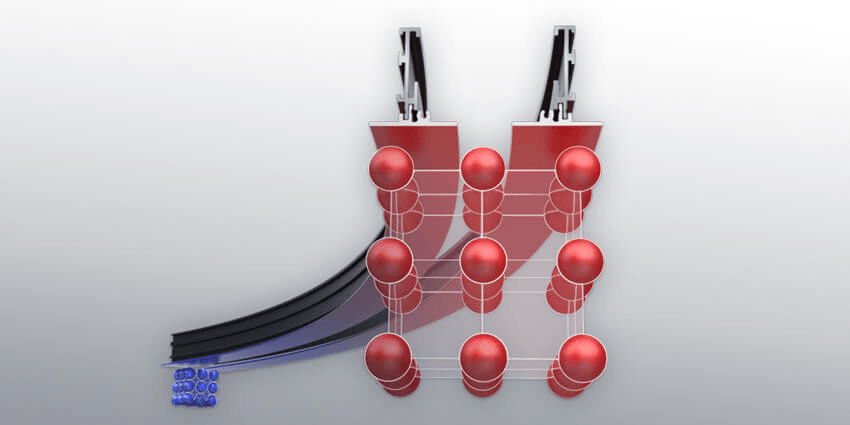
The science behind thermal expansion is fundamental: materials expand when heated and contract when cooled. In an HVAC system, components like an HVAC grille or diffuser are subject to constant temperature fluctuations. During a heating cycle, the material warms and expands; during a cooling cycle, it chills and contracts. Materials commonly used in these components, such as aluminum and steel, have different rates of expansion. Aluminum, for instance, expands and contracts at nearly twice the rate of steel for the same temperature change. These cyclical changes exert physical force on the component and its mounting points, creating a recurring stress cycle every time the system runs.
The most common indicator of unmanaged thermal movement is auditory. That distinct popping or clicking sound is the audible release of stress built up within a rigidly fixed grille or diffuser. As the material contracts or expands, it is constrained by its fasteners until the force overcomes the static friction, resulting in a sudden, noisy shift. Over time, this recurring stress manifests in physical damage. Visual symptoms include:
These are not signs of a defective product but rather of an installation that failed to account for the laws of physics.
The most effective way to mitigate thermal stress is to minimize the temperature difference between the material at the time of installation and its average temperature during operation. This is the principle of thermal equilibrium. Installing a cool metal diffuser in a hot room—or vice versa—creates a significant temperature gap. When the HVAC system is turned on for the first time, the material undergoes a dramatic size change, causing a \”thermal shock\” that induces maximum initial stress. The goal is to install the component when it is as close as possible to its future operational temperature, effectively pre-acclimating it to its working environment.
To apply the principle of thermal equilibrium in the field, professionals can follow a simple yet powerful guideline: install grilles and diffusers when the ambient temperature is within 10-15°F of the expected supply air temperature. For a cooling system with a target supply air temperature of 55°F, this means the ideal installation window is when the room temperature is between 65°F and 70°F. This practice drastically reduces the initial contraction the material will experience, preventing the buildup of stress that leads to noise and damage from the very first system cycle.
A long linear diffuser is particularly susceptible to the failures of rigid installation. When every available mounting hole is secured with a tightly fastened screw, the diffuser is locked in place. As the material naturally attempts to contract or expand, this rigid mounting scheme provides no room for movement. The stress is then transferred directly into the material itself, causing it to bow or warp, or into the surrounding drywall, causing it to crack. This approach treats the diffuser as a static architectural element rather than a dynamic component interacting with its thermal environment, setting the stage for inevitable failure.
To prevent stress buildup, the installation must allow for slight, controlled movement. This is especially critical for long aluminum diffusers where total contraction can be significant. Flexible mounting can be achieved with several techniques:
These methods ensure the linear diffuser remains stable and flush while accommodating the natural physics of thermal contraction.
To move from estimation to engineering, professionals can calculate the precise amount of movement to expect. This is done using the material’s Coefficient of Thermal Expansion (CTE), denoted by the Greek letter alpha (α). The formula is straightforward:
ΔL = α * L * ΔT
Where:
Common CTE values for HVAC materials are:
This calculation empowers installers to quantify the expected movement and design an appropriate flexible mounting strategy.
Let’s apply this formula to a common scenario to illustrate its importance.
Material choice has a direct impact on thermal performance. When selecting an HVAC grille or air vent grille, it’s crucial to weigh the properties of aluminum and steel. Aluminum is lightweight, corrosion-resistant, and easily extruded into complex profiles, making it a popular choice. However, its high CTE means it moves significantly more with temperature changes. Steel, with a CTE roughly half that of aluminum, is far more dimensionally stable. The trade-off is its heavier weight and susceptibility to rust if its protective coating is compromised. For applications demanding minimal thermal movement, steel is often the superior choice, provided its weight and finish are appropriate for the installation.
In environments with extreme conditions, such as natatoriums, industrial kitchens, or regions with dramatic daily temperature swings, material selection is even more critical. High humidity and corrosive agents can quickly degrade standard materials. In these scenarios, stainless steel offers an excellent balance of low thermal expansion and superior corrosion resistance. Alternatively, specialized coatings and anodized finishes on aluminum can enhance its durability, protecting it from environmental degradation while still requiring a robust strategy to manage its higher rate of thermal expansion.
One of the most frequent and damaging mistakes is installing grilles and diffusers in a new construction project before the building’s climate is stabilized. An installer working in a 95°F, unconditioned building sets up a worst-case scenario for thermal shock. When the HVAC grille is installed at this peak temperature, the subsequent introduction of 55°F supply air creates a massive 40°F temperature differential. This forces the maximum possible material contraction, virtually guaranteeing loud popping noises and placing extreme stress on the unit and its surroundings from the moment the system is activated.
HVAC professionals are well-versed in managing thermal expansion in piping systems using expansion loops or flexible joints. However, it is a critical error to apply that thinking to Grilles, Registers, and Diffusers (GRDs). The solutions for GRDs are fundamentally different because they must preserve aesthetics and airflow performance. An expansion loop on a linear diffuser is not feasible. Instead of absorbing movement along the run, GRD solutions must accommodate it at the point of installation. The focus must remain on two key strategies: temperature-synchronized installation to minimize the thermal delta and flexible mounting techniques to allow for subtle, frictionless movement.
The persistent clicks and pops from an HVAC system are not inevitable side effects but direct consequences of overlooking the physics of thermal expansion. By treating grilles, registers, and diffusers as dynamic components rather than static fixtures, HVAC professionals can proactively eliminate the root cause of noise and structural strain. The solution is not complex but requires a shift in installation philosophy from rigidity to managed flexibility.
The core principles of success are clear: synchronize the installation temperature with the operational temperature to minimize thermal shock, employ flexible mounting techniques that allow materials to move naturally, and select materials with thermal properties appropriate for the environment. By integrating these practices, installers can prevent costly callbacks, protect architectural finishes, and deliver a system that performs as silently as it does efficiently. Ultimately, this foresight elevates the quality of work, ensuring system longevity and complete client satisfaction.