Need Specifications or a Quote?
Share your ventilation project requirements and our engineers will reply within 12 hours with technical specs, pricing, and lead time.
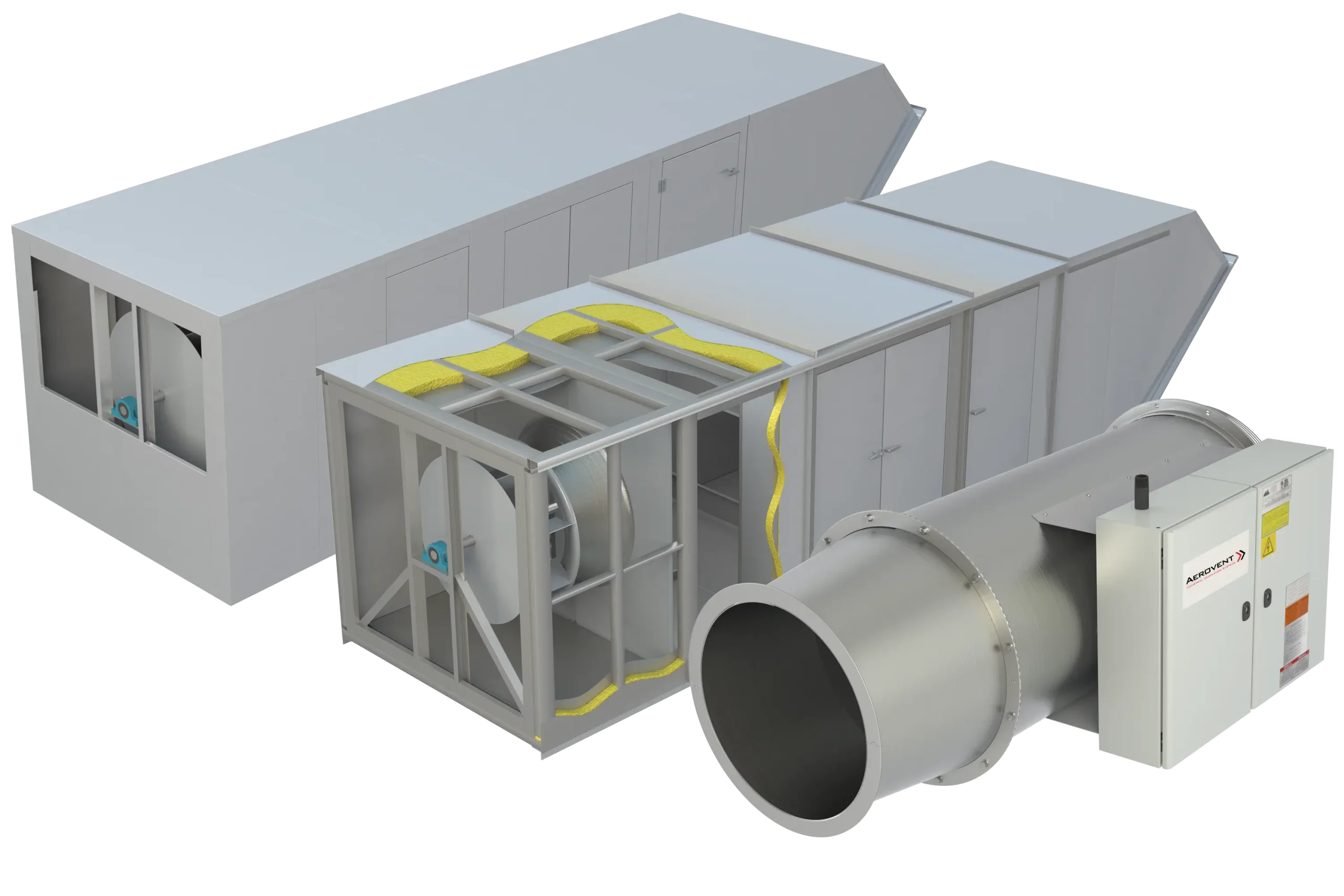



Warehouses and factories present unique challenges for ventilation and air distribution. These buildings typically have large internal volumes, uneven heat loads, high ceilings, and process-related pollutants or particulate concentrations. Simply increasing fan size or adding more airflow does not guarantee effective ventilation. The key is to design airflow patterns that maintain stable mixing, control temperature stratification, and ensure that contaminants do not accumulate in occupied zones.
As explained in HVAC Air Duct System Basics, duct systems influence air quality, comfort, and energy consumption. In industrial environments, these effects are amplified due to long horizontal duct runs, diverse equipment heat loads, and varying occupancy zones. Effective warehouse and factory ventilation requires understanding how air moves across large spaces and how duct geometry, velocity, and exhaust placement interact.
Ventilation strategies begin with understanding the internal environmental loads. These loads vary significantly depending on facility type, process equipment, storage arrangement, and production operations.
Warm air rises. In high-bay warehouses or production halls, heat from equipment, lighting, or occupants migrates upward, accumulating in the upper portion of the space. This creates temperature layers, or stratification. While the air near the floor may feel comfortable, the roof area may exceed comfortable temperature by 10°C (18°F) or more. Without proper mixing, this heat remains unused and forces mechanical cooling systems to run inefficiently.
Factories involved in cutting, grinding, welding, spraying, packaging, or food handling generate dust, smoke, vapors, or aerosols. Without adequate airflow removal or directional control, contaminants accumulate in work zones and affect worker health and product quality.
Warehouse airflow is rarely uniform. Loading docks, picking lines, packaging zones, and inspection areas require different ventilation intensities. A single system design treating the entire building as one uniform volume often performs poorly.
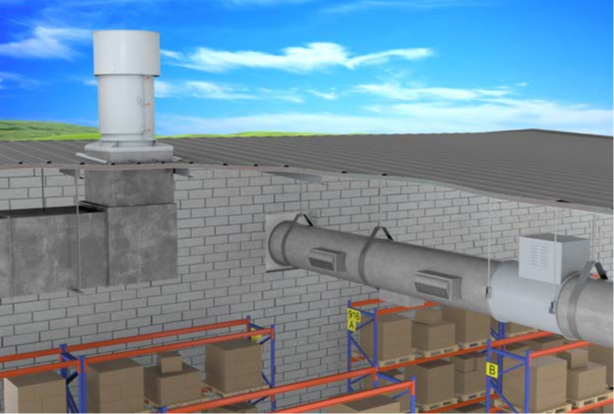
Airflow patterns determine whether ventilation achieves dilution, removal, and thermal comfort. Large spaces require stable circulation loops, not just air movement.
High supply air velocity encourages mixing and helps break down thermal stratification. This approach works when uniform conditions are needed across the space. However, excessive mixing may disturb dust or increase energy load if warm ceiling air is reintroduced to the occupied zone without control.
Displacement ventilation introduces air at low velocities near the floor. Heat sources create vertical convective plumes that lift contaminants upward. This approach is beneficial for facilities requiring high air quality near worker breathing levels. However, it requires careful planning of return air height to avoid recirculating polluted layers.
High-volume low-speed (HVLS) ceiling fans help redistribute air vertically. They are not ventilation devices themselves but can dramatically improve the uniformity of temperature zones. When used alongside ducted supply, they reduce energy waste by allowing setpoints to adjust upward without reducing comfort.
Duct system layout impacts the effectiveness of airflow distribution. Long runs, elevation changes, and varying branch loads must be considered.
Factories benefit from large trunk ducts running along work zones with multiple branch takeoffs. Consistent static pressure control is critical to maintaining flow balance. Systems that rely heavily on dampers to correct imbalance often suffer from energy inefficiency and persistent field complaints.
Spiral ducts offer lower friction loss and improved leakage performance, making them suitable for large spaces. As discussed in Spiral Duct Energy Efficiency Performance, the smooth airflow behavior reduces fan pressure requirement and long-term operating cost.
Certain areas require rectangular ducts due to height constraints or architectural coordination. The choice between rectangular and round configurations should align with system performance priorities, as noted in Rectangular vs Spiral Ducts.
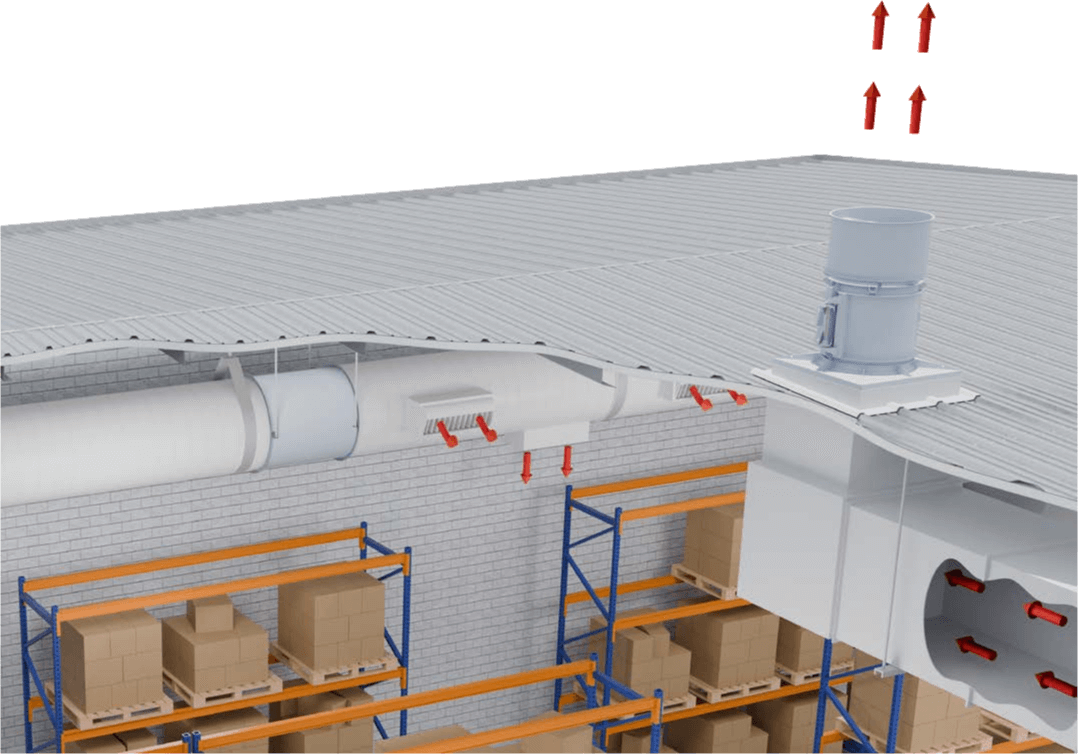
Different industrial applications require different ventilation goals:
In facilities with large open volumes, stack effect can be used to remove heat and contaminants by exhausting air through elevated roof vents. However, natural ventilation is highly dependent on climate, wind conditions, and building envelope design.
Duct sizing must reflect airflow requirements and mixing behavior, not just total airflow volume. Oversized ducts result in low velocity and weak mixing. Undersized ducts increase noise, turbulence, and static pressure.
The correct sizing process follows the same logic outlined in How to Size Air Ducts, which emphasizes balancing airflow volume with velocity and friction loss.
Typical warehouse ventilation requires 3–8 air changes per hour (ACH), depending on climate, pollutant load, and occupancy. Factories may require higher ACH due to active production processes generating heat and contaminants.
In tall spaces, supply air should be introduced at heights that match thermal layers. Return or exhaust should be placed at elevations that remove stratified contaminants effectively. Incorrect height placement results in wasted energy and uneven performance.
Ventilation efficiency depends on maintaining acceptable air quality. When contaminants are present, filtration and extraction system placement are critical.
Filtration should be placed where contaminants are concentrated. Placing filters only at air handling units may not ensure sufficient local air quality if pollutants are generated at specific production points.
Energy efficiency strategies aim to reduce fan power consumption and optimize environmental control.
Stratification control strategies (such as HVLS fans) can significantly reduce heating energy consumption in cold climates by distributing warm air downward into occupied zones.
High supply ducts above rack aisles with mid-height return ducts to prevent stratification and improve mixing.
Localized extraction hoods for heat and pollutant sources, combined with overhead supply for general dilution ventilation.
Large-diameter spiral duct trunks distribute air across long spans, with HVLS fans supporting vertical mixing to reduce heating costs.
Effective warehouse and factory ventilation depends on understanding air movement patterns, heat stratification, pollutant concentration, and the interaction between supply and exhaust placement. The goal is not to simply move large quantities of air, but to deliver airflow that is stable, efficient, and targeted to the needs of the space. When airflow is designed as a system strategy rather than a volume calculation, both comfort and efficiency improve.
If you have warehouse or factory ventilation layout drawings or air quality requirements, our engineering team can assist in designing and optimizing airflow distribution systems.


