Need Specifications or a Quote?
Share your ventilation project requirements and our engineers will reply within 12 hours with technical specs, pricing, and lead time.
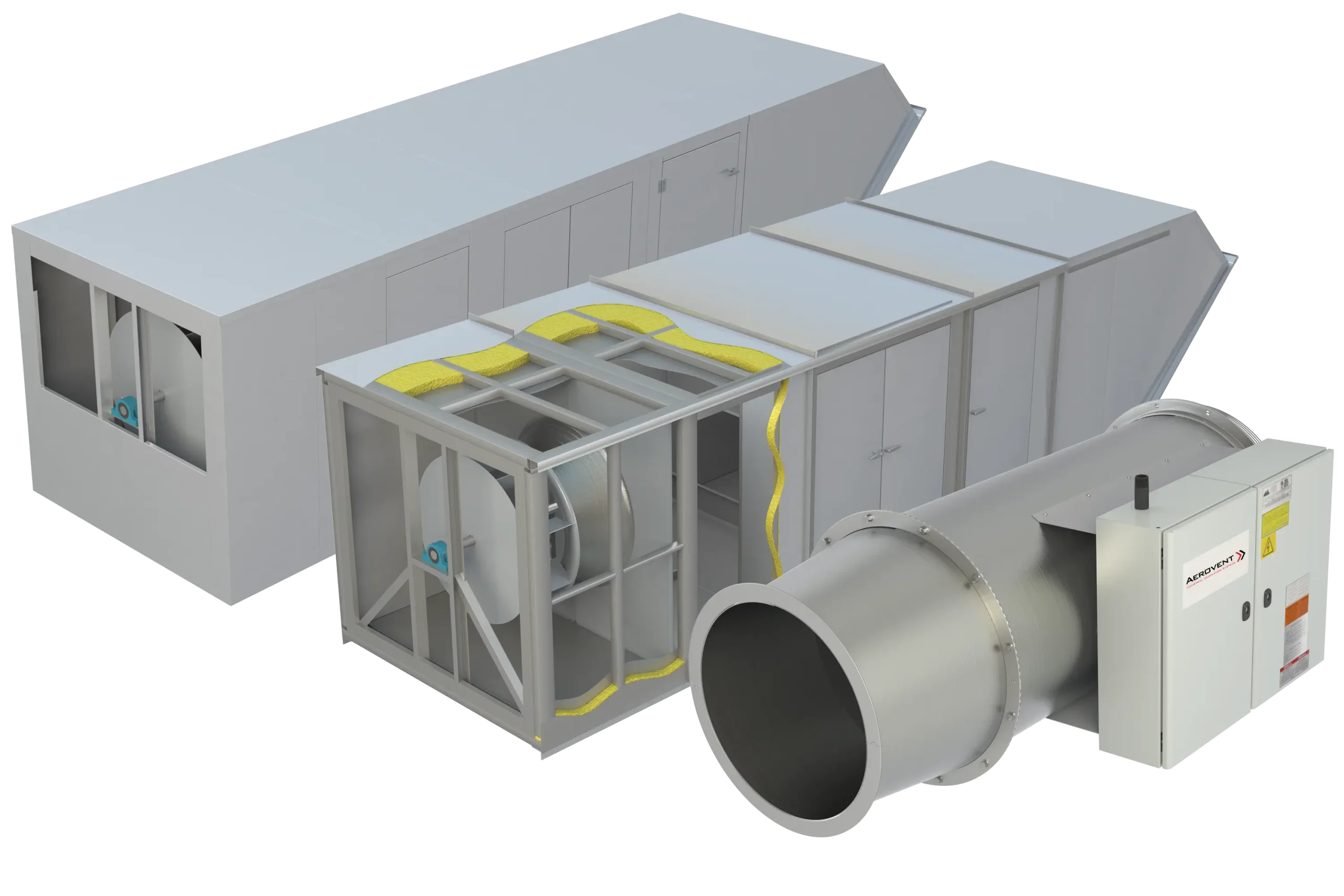



The geometry of air ducts influences how air moves inside the HVAC system. Airflow behavior affects energy consumption, system noise, and long-term stability of ventilation performance. When air travels through a duct, it encounters friction along the interior surfaces and turbulence caused by changes in direction, fittings, and transitions. The level of turbulence and friction determines the static pressure required from the fan to deliver the intended air volume to occupied spaces.
Spiral ducts have become widely preferred in commercial buildings, transport terminals, warehouses, retail malls, and industrial facilities because their circular geometry reduces friction resistance and leakage. The resulting system performance benefits include lower fan horsepower, quieter operation, and more predictable airflow delivery across large distances. Understanding why spiral ducts provide these benefits helps engineering teams select duct configurations based on performance goals rather than habit or cost alone.
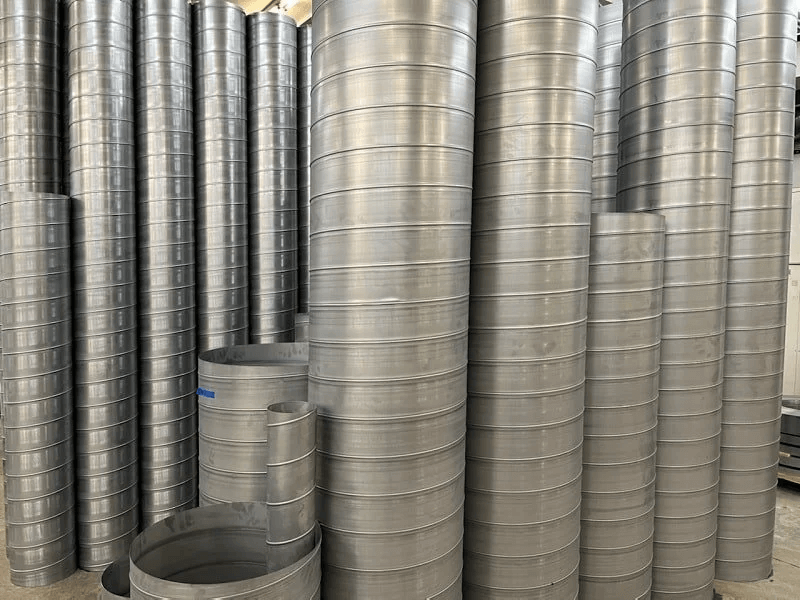
Spiral ducting is constructed by forming sheet metal into a continuous spiral seam, creating a smooth cylindrical duct. The manufacturing process uses a rolled coil of galvanized steel, stainless steel, or aluminum that is progressively shaped and locked into its final form. Standard lengths are typically 3 to 6 meters, depending on region and handling requirements.
Spiral ducts can accommodate:
Because of their uniform cylindrical geometry, spiral ducts maintain consistent cross-sectional area, reducing flow disturbances and making airflow behavior easier to predict during system design.
Reference: Spiral Duct and Fittings
Airflow in a duct is influenced by its cross-sectional shape. Round ducts minimize surface area relative to airflow volume, reducing friction losses. In rectangular ducts, air moves unevenly, particularly in corners, where turbulence forms and increases resistance.
In spiral ducts, the circular cross-section encourages uniform velocity across the airflow profile. This reduces the static pressure the fan must overcome to maintain target airflow. Lower pressure translates directly into lower energy consumption.
Spiral ducts better maintain laminar flow compared to rectangular ducts. Turbulence not only wastes energy but can also increase noise levels. Spiral ducts minimize velocity fluctuations that contribute to instability in airflow delivery.
Measured performance data show that round ducts require less pressure to move the same volume of air compared to rectangular ducts of equivalent capacity. Reduced pressure drop means smaller fans or lower fan operating speeds, lowering energy use, mechanical stress, and noise.
Air duct leakage occurs at joints, seams, and transitions. Leakage reduces delivered airflow and forces fans to work harder. The more seams and joints, the greater the risk of leakage.
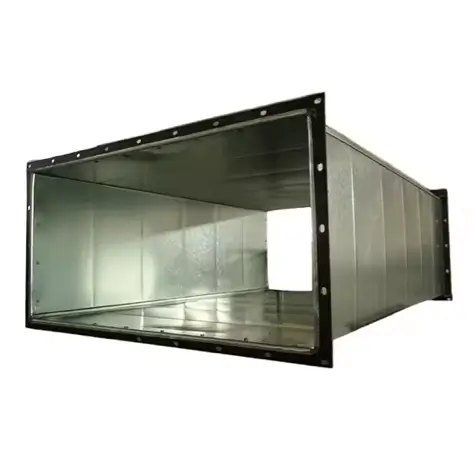
Rectangular ducts require panel seams, corner seams, and flange systems to form duct connections. Each of these interface points must be carefully sealed during installation. Field variations in sealant application can lead to inconsistent leakage control.
Comparison reference:
Rectangular Duct Sections
Spiral Duct Configurations
Airflow velocity and turbulence generate noise. Additionally, duct surfaces vibrate in response to pressure and airflow changes. The geometry and stiffness of the duct influence how noise is transmitted to occupied spaces.
Spiral ducts produce less turbulence, resulting in lower broadband noise levels. This is particularly useful in open-ceiling spaces where ductwork remains exposed. Instead of concealing ducts behind acoustic ceilings, spiral ducts allow functional systems to become part of the architectural design.
Rectangular ducts have large flat surfaces that can resonate when airflow velocity changes. Spiral ducts, with their rounded profiles, distribute internal pressure more evenly, reducing resonance and improving noise control.
The spiral seam of the duct adds rigidity to the structure. This allows spiral ducts to achieve equivalent or greater strength with thinner material than rectangular ducts made of heavier gauge sheet metal.
Because spiral ducts distribute loads evenly, hanger spacing can be increased without compromising structural integrity. This reduces the amount of suspension hardware and installation labor.
Spiral ducting is particularly suited to exposed ceiling designs. The clean cylindrical appearance provides an intentional, architectural finish without additional cladding or concealment.
Energy use is one of the primary cost drivers in HVAC systems over their operational lifespan. Spiral ducts contribute to energy efficiency by reducing pressure drop and leakage.
These factors combine to reduce annual operating costs. Over a building lifespan of 20–40 years, the cost difference between spiral and rectangular duct systems can be substantial.
Spiral ducting performs well in environments requiring efficient airflow over long distances, robust mechanical performance, or exposed system aesthetics.
In some projects, rectangular ducts may be used for main trunks in shallow ceiling spaces, while spiral ducts are used for branches. This hybrid strategy balances ceiling clearance constraints with efficiency benefits.
Even when spiral ducts are selected, improper sizing or installation can reduce performance.
Designers should reference airflow velocity, pressure loss, and duct sizing charts to ensure consistent performance across varying load conditions.
Spiral ducts improve airflow efficiency, reduce system noise, and enhance leakage performance due to their aerodynamic geometry and structural stability. They offer measurable energy savings over the lifespan of HVAC systems and simplify installation by reducing reinforcement requirements. Spiral ducting is especially effective in open ceiling spaces, large commercial interiors, and long-run ventilation systems where predictable airflow performance is essential.
If you have project drawings, specifications, or airflow requirements, our engineering team can assist with product matching and fabrication planning.


