Need Specifications or a Quote?
Share your ventilation project requirements and our engineers will reply within 12 hours with technical specs, pricing, and lead time.


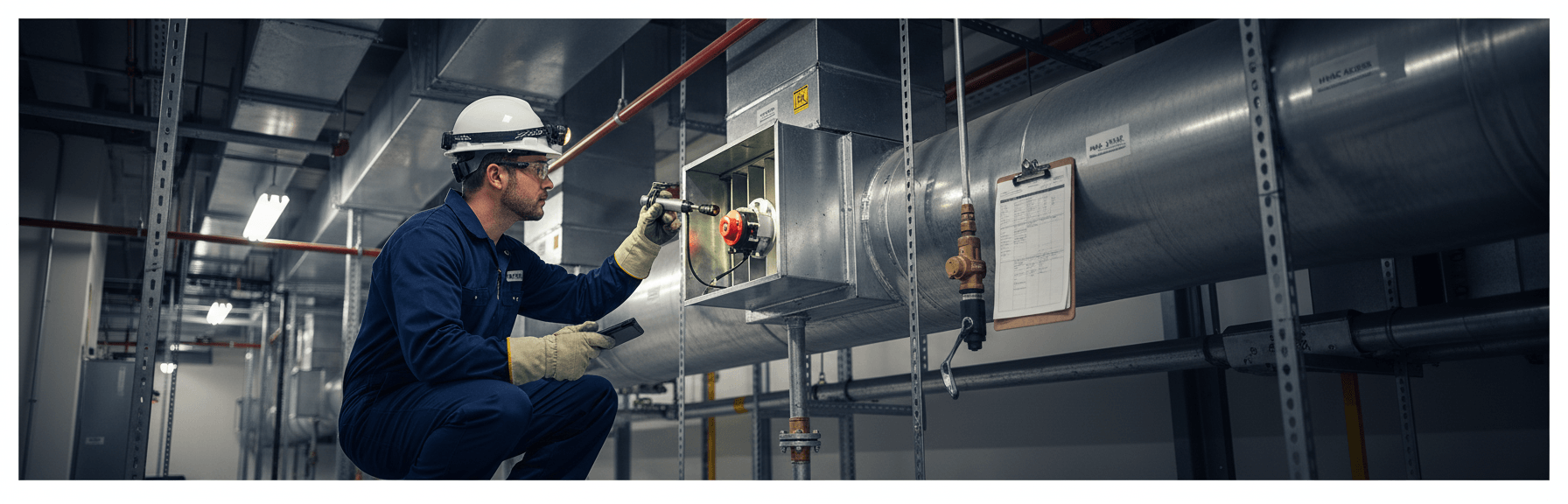
Fire and smoke dampers are the silent, unseen guardians of a building’s life safety system. Tucked away within ductwork, their role is to automatically halt the spread of fire and smoke, compartmentalizing an incident and providing critical time for occupant evacuation. While essential, these devices are often forgotten, creating a significant compliance and safety risk for facility managers who may not realize their program has fallen short until an audit or, worse, an emergency.
The effectiveness of a fire damper is entirely dependent on its ability to function flawlessly when called upon. This reliability is not a given; it is the direct result of a systematic program of inspection, testing, and maintenance (ITM). Without regular verification, a damper can become seized by rust, blocked by debris, or disconnected from its controls, rendering it useless. Establishing a compliant inspection program is not merely about ticking boxes; it’s about upholding a non-negotiable duty of care.
This guide provides a definitive checklist and a strategic framework for managing your fire and smoke dampers. We will move beyond basic procedures to explore the nuances of NFPA standards, documentation, and the often-overlooked prerequisite of physical access, enabling you to build a program that ensures both safety and regulatory compliance.
Before any inspection can be performed, a clear understanding of what these devices do and the standards that govern them is essential. A fire damper is a mechanical device designed to close upon the detection of heat, using a fusible link that melts at a specific temperature. A fire smoke damper combines this feature with an actuator that closes the damper upon receiving a signal from a smoke detector or fire alarm system. This dual-action capability is critical for stopping the circulation of toxic smoke, which often poses a greater threat to life than flames.
These dampers are integral components of a building’s passive fire protection system, working within the HVAC ductwork that penetrates fire-rated walls, floors, and ceilings. Their function is directly tied to the type of ventilation system. In a static system, the fans shut down during a fire event, and the dampers close in still air. In a dynamic system, fans may continue to run for smoke control purposes, requiring dampers that are rated to close against operational airflow. Using the wrong type of damper for the system design can lead to complete failure during an emergency.
Compliance is not arbitrary; it is dictated by two primary standards from the National Fire Protection Association (NFPA). NFPA 80, the Standard for Fire Doors and Other Opening Protectives, provides the definitive requirements for the inspection, testing, and maintenance of fire dampers. For smoke control, NFPA 105, the Standard for Smoke Door Assemblies and Other Opening Protectives, outlines the procedures for smoke and combination fire smoke dampers. These standards are not mere suggestions; they are adopted into law by model codes like the International Fire Code (IFC) and enforced by the local Authority Having Jurisdiction (AHJ), such as a city fire marshal, making adherence mandatory.
A common point of confusion for facility managers is the required frequency of damper testing. The NFPA standards are prescriptive and clear on this topic, establishing a baseline cycle for all facilities while providing a specific exception for healthcare environments. Failing to adhere to these timelines places a building in a state of non-compliance and compromises its life safety integrity.
Every fire and smoke damper must undergo an initial acceptance test as part of the overall ventilation system commissioning. This test must be completed within the first year of installation to verify correct function from the start. Following this initial acceptance, the standard periodic testing frequency for most commercial, industrial, and educational buildings is every four years. This interval ensures that any degradation, such as corrosion or debris accumulation, is identified and corrected in a timely manner.
Recognizing the unique operational challenges of hospitals and patient care environments, the NFPA provides a different schedule for these facilities. Dampers in hospitals are subject to a slightly extended inspection interval of every six years. It is crucial to understand that this extended timeline does not reduce the stringency of the inspection itself. Furthermore, both the four-year and six-year intervals are mandatory for all dampers within the facility, irrespective of their location or ease of access. A damper hidden above a hard-lid ceiling is subject to the same requirements as one with a clearly marked access panel.
A successful inspection is systematic and meticulously documented. Following a phased approach ensures that nothing is overlooked, from initial planning to final reporting. This structured process not only guarantees compliance with NFPA standards but also improves the efficiency and safety of the inspection itself.
Proper preparation is the foundation of an effective damper inspection program. Before any testing begins, your team must:
The test for a standard fire damper is primarily a mechanical one, focusing on its gravity-driven closure mechanism. The step-by-step process is as follows:
During this process, also perform a visual check for physical damage to the frame or blades, and ensure the damper is not installed with breakaway connections intended for ductwork.
A smoke damper inspection is more complex, as it involves verifying the electrical and control components. The procedure requires you to:
Identifying a failure is only half the battle. A damper fails inspection if it does not close fully, shows excessive rust that impedes movement, is blocked by debris or improperly routed wiring, or has a damaged frame. According to NFPA 80, upon discovery of a non-operable damper, repairs must begin “without delay.” This is not a suggestion; it is a mandate. After repairs are completed, the damper must be re-tested to prove it is fully operational before it can be documented as compliant.
Beyond the test itself, a compliant program hinges on two foundational pillars: unimpeded physical access and meticulous record-keeping. Overlooking either of these can invalidate your entire inspection effort in the eyes of an auditor and, more critically, leave your building vulnerable. These elements transform a simple checklist into a defensible safety program.
The most common point of failure in a fire damper maintenance program is the lack of adequate access. A damper cannot be inspected or repaired if a technician cannot see and reach it. NFPA standards require an access door or panel of sufficient size and location to be provided for each damper. This access must allow for unobstructed visual inspection and hands-on maintenance of the fusible link, actuator, and all moving parts.
A small, 8×8-inch access door for a 24×24-inch damper located three feet inside the duct is non-compliant because it makes maintenance impossible. Access points should be large enough and close enough for a technician to work effectively.
Common issues include access doors that are too small, located too far from the damper, or completely absent (e.g., behind hard-lid ceilings or drywall). Remediation, such as installing larger, properly labeled access panels, is a non-negotiable step toward achieving and maintaining full safety compliance.
For an Authority Having Jurisdiction (AHJ), if an inspection is not documented, it did not happen. Detailed records are your only proof of compliance. Every inspection report must contain the following information for each damper:
| Required Information | Description |
|---|---|
| Damper Location/ID | The unique identifier and physical location from your inventory. |
| Inspection Date | The exact date the test was performed. |
| Inspector’s Name | The name and company of the individual who performed the test. |
| Deficiencies Found | A detailed description of any issues discovered (e.g., “Failed to close due to obstruction by data cable”). |
| Proof of Correction | A record of the date and nature of the repair, and confirmation of a successful re-test. |
These records should be organized and stored in a secure, accessible location (digital or physical) for a minimum of three inspection cycles, ready for review during a facility audit.
Achieving long-term compliance requires shifting from periodic, one-off inspections to a holistic Inspection, Testing, and Maintenance (ITM) strategy. A proactive program anticipates needs, streamlines workflows, and integrates fire life safety into the fabric of your facility’s operations. This approach turns a recurring requirement into a manageable and predictable process.
A comprehensive program begins with your damper inventory. Use this master list to create a multi-year schedule that maps out inspection deadlines based on the four-year (or six-year for healthcare) cycle. This allows for proactive planning and budgeting. Next, assign clear responsibilities. Decide whether a trained in-house team will perform inspections or if you will partner with a qualified third-party contractor specializing in fire damper services. Clearly defining who is responsible for scheduling, testing, repairs, and record-keeping eliminates ambiguity and ensures accountability.
To ensure your ITM strategy is executed consistently, embed it into your existing operational systems. If your facility uses a Computerized Maintenance Management System (CMMS), create recurring work orders for damper inspections that are automatically assigned based on your multi-year schedule. This formalizes the process and provides a digital trail of all related activities. Furthermore, effective budgeting is key. Your facility’s annual budget should account not only for the cost of inspections but also for a contingency fund for potential repairs and access remediation projects. Planning for these expenses prevents critical life safety repairs from being delayed due to a lack of funds.
In summary, an effective fire and smoke damper program is not an isolated event but a continuous cycle of preparation, inspection, documentation, and remediation. The foundation rests on a thorough understanding of NFPA 80 and 105, which dictate not just the “how” but also the “when” of damper testing. Adhering to the mandatory four- or six-year inspection intervals is the first step toward compliance, but true safety is achieved through diligent execution.
The process demands distinct procedures for mechanical fire dampers and actuated smoke dampers, immediate action on any failures, and meticulous record-keeping to satisfy auditors. Perhaps most critically, it requires a commitment to providing clear physical access for every damper—without it, all other efforts are compromised. By shifting from a reactive checklist mentality to a proactive, fully integrated ITM program, you transform a regulatory obligation into a core pillar of your building’s life safety strategy.
Ultimately, a well-maintained damper inventory is more than just a compliant asset; it is a life-saving system. Investing in a structured, long-term maintenance program protects your property, ensures the safety of your occupants, and solidifies your facility’s resilience against the threat of fire.