Need Specifications or a Quote?
Share your ventilation project requirements and our engineers will reply within 12 hours with technical specs, pricing, and lead time.


In HVAC systems, the temperature of supply air often differs significantly from the surrounding environment. When cold air travels through warmer spaces or warm air travels through cooler spaces, the duct surface can develop condensation. If not controlled, condensation can drip into ceilings, damage insulation, encourage mold growth, and lead to long-term maintenance issues. Insulated ducting helps maintain stable air temperature throughout the system, reduces condensation risk, and improves energy efficiency.
Insulation also contributes to acoustic comfort. Air movement inside ducts can create vibration and airflow noise. In environments such as hotels, offices, theaters, and hospitals, sound control is critical to maintaining occupant comfort. For this reason, the selection of duct insulation is not only about preventing energy loss but also managing airflow noise and system behavior under real operating conditions.
Understanding the difference between single-wall ducting and double-wall insulated ducting helps engineers and contractors choose the correct configuration based on building type, environmental conditions, and performance expectations.
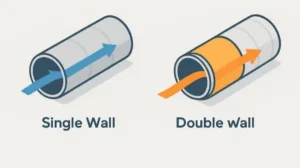
Single-wall ducting consists of a single layer of sheet metal, typically galvanized steel, stainless steel, or aluminum. It forms the basic structure of an air distribution system. Single-wall ducts are widely used because they are simple to fabricate, cost-effective, and suitable for most general ventilation applications.
However, when temperature differences exist between the supply air and surrounding ambient conditions, insulation must be applied externally to the duct surface. External insulation may consist of fiberglass blankets, mineral wool wraps, or foam insulation boards secured with tape, mesh, or aluminum foil cladding.
See product reference: Air Duct Systems | Rectangular Duct Configurations | Spiral Duct Systems
Double-wall ducting consists of two concentric layers of metal with insulation installed between the inner and outer layers. The inner duct carries the airflow, while the outer duct provides mechanical protection for the insulation. The insulation layer is typically fiberglass or mineral wool, selected based on thermal resistance and acoustic performance requirements.
For reference: Double Wall Rectangular Duct
In buildings where chilled air is supplied, especially in humid climates, condensation control is a critical design requirement. Single-wall ducts rely on external insulation, which must remain intact to prevent moisture accumulation. Double-wall ducts offer more reliable thermal control because the insulation is sealed within the structure.
Airflow velocity and turbulence cause vibration and noise in duct systems. Single-wall ducts often require internal acoustic lining or thicker external insulation to reduce noise transmission. Double-wall ducts naturally absorb sound through their insulation layer, making them suitable for hospitals, hotels, cinemas, and conference facilities where sound quality is important.
Double-wall ducts have increased stiffness due to the dual metal layer construction. This reduces duct deformation in long horizontal runs and helps maintain consistent airflow distribution. Single-wall ducts may require reinforcement frames or hangers when installed across wide spans.
Double-wall ducts require more space due to the insulation layer and outer casing. This is important when ceiling voids are shallow or when mechanical and electrical systems must share routing pathways. In low-clearance spaces, single-wall ducts with external insulation are easier to fit.
Double-wall ducts are easier to clean because insulation is not exposed. In single-wall systems with internally lined insulation, dislodged fibers or particulate release must be considered in healthcare and clean facilities.
Single-wall ducts with external insulation have a lower initial material cost. However, maintenance and repair costs can be higher if insulation is damaged or moisture penetrates the insulation layer.
Double-wall ducts have higher initial fabrication cost but provide long-term savings in:
Lifecycle cost analysis is recommended when specifying duct type for buildings with high occupancy or long operational duration.
Single-wall ducts with external insulation are typically sufficient. They offer a balance of cost and performance.
Double-wall ducts improve acoustic comfort and reduce disturbance from HVAC operation.
Double-wall ducts help prevent condensation and maintain stable air temperature along extended routes.
Single-wall ducts with durable insulation jacketing provide cost-effective ventilation when aesthetics and acoustics are not primary concerns.
Single-wall ducting is suitable for most general ventilation applications where cost efficiency and flexibility are priorities. Double-wall ducting is recommended where thermal stability, noise control, or condensation resistance are critical. The final selection should be based on operating environment, temperature differential, acoustic expectations, maintenance accessibility, and lifecycle cost analysis.
If you have project drawings, specifications, or airflow requirements, our engineering team can assist with product matching and fabrication planning.


