Need Specifications or a Quote?
Share your ventilation project requirements and our engineers will reply within 12 hours with technical specs, pricing, and lead time.



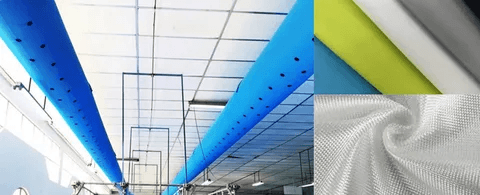
Fabric air ducts are engineered air distribution systems. They use specialized polyester or polyethylene fabrics.
Metal ducts transport air. Fabric ducts transport and diffuse air. The entire surface of the duct distributes air evenly into the conditioned space. Metal is heavy, corrodes, and needs significant structural support. Fabric is lightweight, flexible, and resists rust.
Fabric ducts deliver air differently. Air distributes uniformly along the duct’s length. This happens through either permeable fabric or engineered micro-perforations.
This design creates a low-velocity, even airflow. It eliminates drafts, noise, and the hot/cold spots common with metal systems. Metal systems “dump” high-velocity air from a few registers, leading to poor air mixing. The HVAC system then works harder to maintain a uniform temperature. Fabric systems create a more stable environment, improving the efficiency of the entire industrial ventilation system.
The material is up to 90% lighter than metal. This reduces shipping and handling costs.
This weight advantage also simplifies installation. A two-person team can often complete a project in a fraction of the time. You do not need heavy lifting machinery or extensive structural reinforcements. This accelerated timeline reduces labor costs by as much as 30%. For you, that means shorter project schedules and a lower total installed cost. Assembly is simple, typically using suspended cable or track systems.
HVAC fabric ducting provides significant long-term energy efficiency. Metal ductwork leaks at seams, joints, and connections. Industry estimates place typical leakage rates between 10% and 25%. This lost conditioned air is a direct energy waste.
Fabric ducting is a seamless, airtight system. This construction eliminates leakage. Nearly 100% of the conditioned air from the AHU reaches its intended space. The even air dispersion also allows for higher thermostat setpoints. You can reduce energy consumption without affecting occupant comfort. Over the system’s life, these operational savings directly reduce utility bills.
Air leakage in metal systems and the dispersion efficiency of fabric create a performance gap. Your HVAC system performance improves when you prevent the energy waste inherent in leaky metal ducts.
Also, fabric is non-corrosive. This maintains efficiency over time. Metal ducts rust and degrade in humid environments, which worsens leaks and impedes airflow. Fabric maintains its material integrity.
For example, a food processing plant switched to fabric ducting. They reported a 15% reduction in HVAC energy consumption. This was due to eliminated air leakage and improved air mixing, saving over $50,000 annually.
Beyond cost, fabric ducts offer critical advantages for indoor air quality (IAQ). Customizable micro-perforations create a gentle, draft-free airflow. This eliminates the discomfort from high-velocity metal registers.
Fabric systems are also more hygienic. The smooth, non-porous interior inhibits the accumulation of dust and microbial contaminants. These often collect on the rough surfaces of metal ductwork. The fabric is non-condensing and can be treated with anti-microbial agents. This prevents the growth of mold and bacteria—a common issue in damp metal systems.
Fabric ducting also offers acoustic benefits. Metal is a hard, reflective surface. It amplifies system noise and transmits vibrations, rumbling, and air rush sounds.
Fabric is a sound-absorbing material. It dampens operational noise from the air handling unit. It also eliminates the rattling common in rigid duct systems. This creates a quieter indoor environment. You do not need to add costly sound-attenuating insulation.
The maintenance advantages of fabric ducts are clear. Cleaning metal ductwork is a difficult, disruptive, and expensive process. It requires manual scrubbing, chemical agents, and significant system downtime.
Fabric ducts change this process. The system is designed for easy removal. You can unzip and take down sections without specialized tools. Once removed, the ducts can be commercially laundered. This removes 100% of surface contaminants. This simple process ensures system hygiene, reduces labor costs, and minimizes operational downtime. It also eliminates corrosion risk from the harsh cleaning chemicals used on metal.
Fabric ducting gives you design freedom. Metal imposes constraints on layout. Fabric can be customized to fit complex architectural or structural layouts.
This flexibility is valuable in specialized environments:
This adaptability makes fabric a strong solution for new construction and retrofits.
HVAC fabric ducting is the better choice for many applications. Its hygienic properties fit environments with strict cleanliness standards. Its non-corrosive nature suits humid or chemically aggressive settings.
Key use cases include:
When specifying fabric ducting, these factors ensure optimal performance. You must understand the space’s demands to select the right system.
Actionable considerations:
Fabric duct systems are significantly more cost-effective than metal. The material costs are typically 20% to 80% lower than comparable metal systems. Additionally, because fabric ducts are lightweight and modular, installation is much faster—often reducing labor time by 50% to 70%. This results in substantial savings on both the initial capital investment and total project downtime.
Yes. Traditional metal ducts often create uncomfortable “drafts” and “dead zones” by blasting air through spaced-out diffusers. Fabric ducts, however, use the entire length of the duct to disperse air. Through permeable fabric or linear vents, they provide uniform, draft-free air distribution. This eliminates hot/cold spots and maintains a consistent temperature throughout the facility, which directly improves employee comfort and productivity.
Absolutely. Fabric ducts are often preferred in hygiene-critical industries. Unlike metal ducts, which are difficult to clean and can harbor mold or dust, fabric ducts can be easily unzipped and laundered in commercial washing machines. Many systems also feature antimicrobial fabrics specifically engineered to prevent bacteria growth, making them ideal for food processing plants, laboratories, and cleanrooms.
Fabric ducts are designed to effectively eliminate condensation. By using permeable fabrics, a small amount of supply air passes through the material, creating a “buffer zone” of conditioned air around the duct’s surface. This prevents the temperature difference that causes condensation to form on metal ducts. Consequently, fabric ducts usually do not require the expensive insulation that metal systems need to prevent dripping.
Yes, modern fabric ducts are built for longevity. They are manufactured from heavy-duty, fire-retardant polyesters and fiberglass materials designed to resist wear, tearing, and aggressive chemical environments. Most reputable manufacturers offer warranties ranging from 10 to 15 years. Furthermore, fabric ducts are immune to the dents, scratches, and corrosion that frequently damage metal ductwork over time.