Need Specifications or a Quote?
Share your ventilation project requirements and our engineers will reply within 12 hours with technical specs, pricing, and lead time.


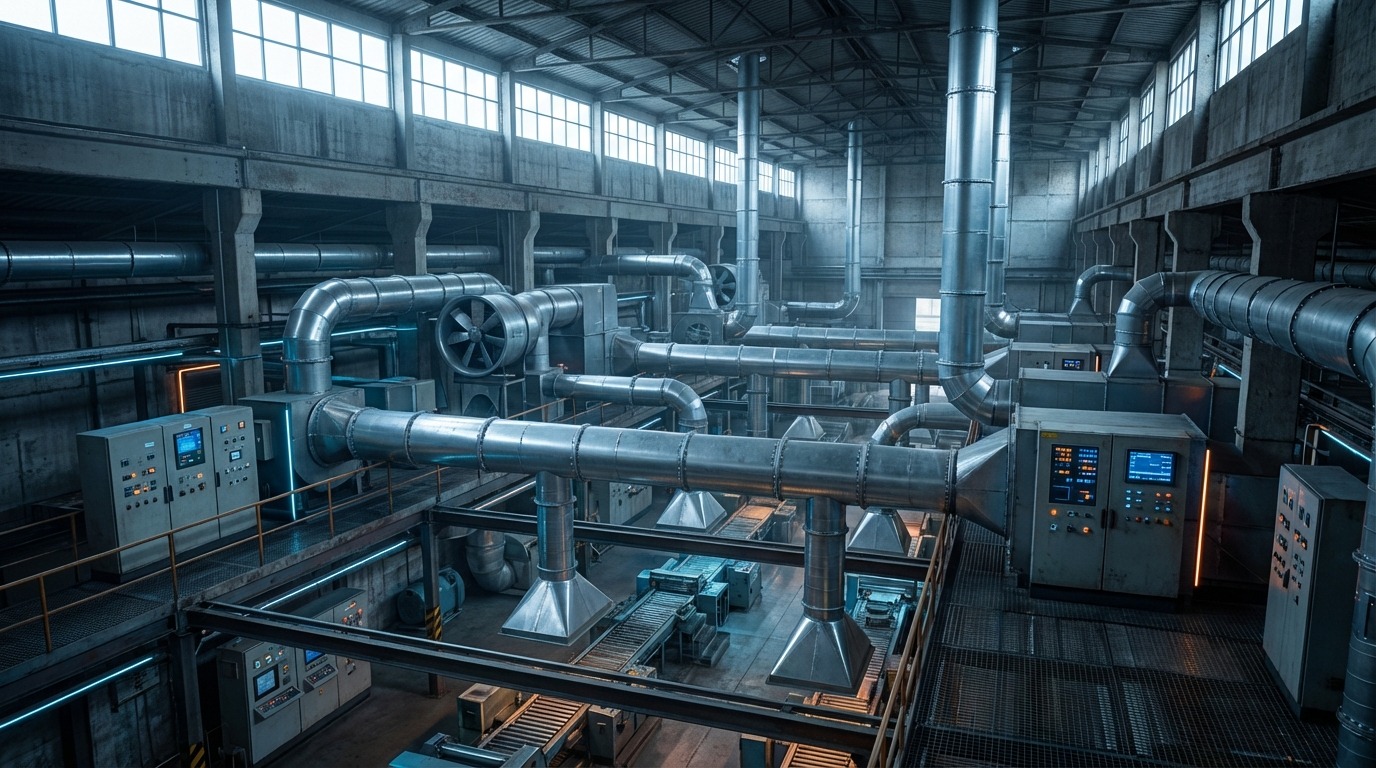
Industrial ventilation systems play a critical role in protecting workers from airborne contaminants like dust, fumes, vapors, mists, and gases.[5][6] Poorly designed systems can cause serious health issues—respiratory diseases, poisoning, cancer risks, discomfort—as well as fire and explosion hazards in environments with combustible dust or flammable vapors.[5][6]
Beyond worker safety, ventilation design impacts regulatory compliance, energy use, and operational costs. Facilities often recognize the need to redesign or upgrade after worker complaints, failed exposure tests, visible dust or corrosion, process changes, or new audits.
A well-designed industrial ventilation system balances three core objectives: effective contaminant control, code compliance, and energy-efficient operation throughout the system’s lifecycle.[2][5] This guide presents a structured, step-by-step approach to support engineers, EHS professionals, and plant managers in informed decision-making.
An industrial ventilation system mechanically provides fresh air and removes contaminated air using supply and exhaust components.[5] It differs from comfort HVAC by focusing on controlling harmful contaminants at or near their source, rather than primarily regulating temperature and humidity for occupant comfort.[3][5][6]
Industrial ventilation demands:
These systems must address particulate settling, corrosion, combustible dust, filtration efficiency, noise, and the energy effect of conditioning large volumes of outdoor air.[2][5]
Local exhaust ventilation is generally more effective than general dilution ventilation for hazardous substances, according to industrial standards.[5]
Industrial ventilation systems divide mainly into:
Other configurations include ambient ventilation systems maintaining background contaminant levels and process-specific systems like paint booths and fume hoods.[2][5] Typically, local exhaust is applied first, supplemented by general ventilation for heat and odor control.
The supply side usually includes:
Proper supply air design avoids interference with contaminant capture at exhaust hoods.
Key exhaust system elements include:
Modern systems use:
Field note: Without proper interlocks, exhaust fans can run without makeup air, creating dangerous negative pressure and compromising contaminant capture.[2]
Start by identifying all contaminant sources, their processes, materials, generation rates, and existing controls.[6] Common contaminants include welding fumes, grinding dust, solvents, acids, combustible dusts, and biological agents.[5][6] Reference applicable occupational exposure limits (OSHA PELs, ACGIH TLVs).
Field observations like smoke tests and air sampling help confirm source characteristics and exposure patterns critical for selecting local exhaust or general ventilation and for demand-controlled ventilation strategies.
Establish clear capture velocities, airflow rates, airborne concentration targets, and room air changes.[2][5] Standards provide velocity examples based on process and hood enclosure degree.[6]
Include temperature, space pressurization, and emission/odor constraints. Early criteria definition avoids under- or over-design, balancing health, compliance, and operating costs.
Choose or design hoods to enclose processes as much as practical—enclosing hoods require less airflow for effective control.[2][6] Where full enclosure is impossible, position receiving or capturing hoods to intercept contaminant flows.[2]
Key design parameters:
Avoid cross-drafts and maintain worker access without compromising containment.[2][5]
Use “balance by design” or blast gates to split airflow per hood requirements while maintaining transport velocities sufficient to suspend particulates.[2][6]
Calculate friction losses through charts and sum losses from fittings, ducts, and hoods to determine total system pressure drops.[2]
Ducts must meet SMACNA industrial construction standards for gauge, reinforcement, and support spacing.[2][6] Include clean-out doors at bends and low points for maintenance.[2]
Select air cleaners based on contaminant type, particle size, temperature, moisture, and whether recirculation will occur.[1][2][5] Options include:
Locate devices outside the building where possible for safety, and plan for pressure drops, maintenance, and waste handling.[2]
Determine exhaust volumetric flow and compute system pressure losses including duct friction, fittings, hoods, and air cleaners.[6]
Choose fan types compatible with the application (centrifugal fans preferred for particulate-laden air).[1][2] Use manufacturer curves to match flow and pressure at peak efficiency.
Energy-efficient motors and VFDs are recommended; fans should have vibration isolation and flexible connectors to reduce noise.[2][4]
Fan selection calculation overview
1. Calculate required exhaust airflow (cfm)
2. Sum pressure losses from ductwork, hoods, filters (inches WC)
3. Identify critical branch with highest total pressure drop
4. Select fan meeting required flow and pressure at peak efficiency from curves
5. Verify motor sizing for startup loads and process conditions
6. Plan for vibration isolation and noise control
Makeup air must match exhaust volume to avoid negative building pressure which causes safety and operational issues.[2][6] Determine whether rooms need slightly negative, neutral, or positive pressure based on process risks.
High-ceiling spaces benefit from perforated ducts or plenums for uniform makeup air distribution avoiding drafts and interference with local exhaust hoods.[2]
Provide interlocks ensuring supply and exhaust fans operate together to maintain safe pressure balance.[2] Include interlocks between process equipment and ventilation where necessary.
Emergency ventilation, alarms for high contaminant levels or fan failures, and room pressure sensors enhance safety and system reliability.[2]
Fire detection integration, fire dampers, and explosion venting are critical for combustible dust or flammable gas environments.
Commissioning & control workflow
– Verify interlock wiring and labeling for supply-exhaust fan pairs
– Test sensor responses (pressure, contaminant levels)
– Configure alarm thresholds and emergency purge modes
– Validate system shutdown interlocks tied to process equipment
– Integrate fire dampers and explosion vents per standards
Prepare detailed line drawings showing hood locations, ducts, fans, air cleaning devices, and dimensions.[2][6]
During installation, follow SMACNA duct standards for construction, supports, and clean-outs. Avoid undocumented changes.
Testing and balancing:
Maintain commissioning records for fan curves, filter types, control setpoints, and baseline pressure readings.[1][2][6]
Welding fumes and grinding dust demand local exhaust ventilation with enclosing hoods or articulated extraction arms.[5][6] Backdraft and side draft hoods capture grinding dust effectively.
Dust collectors (baghouses, cartridge filters) with explosion protection ensure safe handling of combustible metal dusts.[1][2]
Heat loads from welding may require supplemental general ventilation for comfort and equipment cooling.
Spray booths use downdraft or crossdraft ventilation to carry overspray away from painters.[2] Key features include:
Emissions and odor control may call for solvent recovery or carbon adsorption.
These sectors require specialized controls:
Operations generate combustible organic/inorganic dust requiring:
Common mistake: Installing exhaust fans without corresponding makeup air controls is a frequent cause of negative building pressure and ventilation failure. Early coordination of these systems is essential.[2]
Industrial ventilation systems often represent significant facility energy use due to high exhaust volumes and conditioned makeup air.[1][2][5]
Key strategies:
Smart monitoring enables early detection of off-spec operation and efficiency losses, supporting lifecycle cost reduction without compromising safety.
| Energy Efficiency Strategies | Benefits | Typical Application | Implementation Tips |
|---|---|---|---|
| VFD-Controlled Fans | Reduces power at part load | All variable loads | Program for real-time demand |
| Heat Recovery Systems | Cuts heating/cooling costs | Cold climate facilities | Integrate exhaust and supply air |
| Demand-Controlled Ventilation | Matches airflow to need | Processes with variable contaminant generation | Use reliable sensors & controls |
| Efficient Duct Design | Lowers fan energy use | New and retrofit systems | Follow SMACNA guidelines |
| Regular Maintenance | Maintains system efficiency | All installations | Schedule filter and fan checks |
Industrial ventilation design follows multiple standards:
Other applicable codes include NFPA for combustible dust, ASHRAE ventilation guidelines, and local fire/building codes.
Designers should use these as tools, avoiding over- or under-design, and collaborate with engineers, hygienists, and EHS professionals for tailored solutions.
Early collection of detailed information streamlines design and reduces costly changes.
Clear answers help focus on lifecycle performance, reliability, and compliance over initial costs.
Industrial ventilation systems are essential for worker health, safety, and regulatory compliance in industrial settings.[5][6] Effective design integrates properly selected hoods, sized ductwork, suitable air cleaners, balanced supply and exhaust air, and robust controls into a coordinated system.[2][5][6]
Success follows a structured approach: from contaminant identification and performance criteria definition through commissioning and verification, considering future flexibility and energy costs.[2][6]
Facilities should start by documenting processes and contaminants and engage qualified engineers and industrial hygienists familiar with industrial ventilation standards.[2][5][6] Ongoing monitoring, maintenance, and reassessment ensure sustained safety, compliance, and cost-effective operation.
Key takeaways to ensure safety, compliance, and cost efficiency in industrial ventilation design
What are the main components of industrial ventilation systems?
Industrial ventilation systems primarily include supply air components (inlets, filters, heating/cooling units, fans, ducts, registers), exhaust components (hoods, ducts, air cleaners, fans, stacks), and control systems (dampers, VFDs, sensors, interlocks).
How to design an industrial ventilation system for compliance?
Design starts with identifying contaminants and exposure limits, defining performance criteria, selecting proper hoods, sizing ducts for transport velocity, choosing air cleaning devices, fans, and balancing supply and exhaust air, following standards like UFC and ACGIH.[2][5]
What standards should industrial ventilation follow?
Key standards include OSHA exposure regulations, ACGIH Industrial Ventilation Manual, UFC 3-410-04, CCOHS guidance, and SMACNA duct construction standards. Compliance ensures system safety, efficacy, and regulatory acceptance.
How to calculate airflow in industrial ductwork?
Airflow calculation involves determining required capture velocities, sizing ducts to maintain minimum transport velocity, calculating friction and fitting losses to find total pressure drop, and selecting fans to overcome system resistance.[2][6]
What are common challenges in industrial ventilation design?
Common issues include improper makeup air sizing, poor hood placement, insufficient duct velocity leading to plugging, ignoring duct construction standards, lack of interlocks, and reliance on rules of thumb instead of calculations.
How to improve energy efficiency in ventilation systems?
Implement VFDs, demand-controlled ventilation, heat recovery systems, efficient motors, optimized duct design, and regular maintenance. These strategies reduce energy consumption while maintaining control performance.[1][2][5]
What safety measures are essential in industrial ventilation?
Safety requires interlocked supply and exhaust fans, continuous monitoring, alarms for high contaminant levels or equipment failure, emergency ventilation modes, and fire/explosion protection such as fire dampers and dust collector isolation.
How to control noise in ventilation systems?
Noise control involves selecting quiet fan types, mounting fans on vibration-isolating bases with flexible connectors, and designing smooth duct transitions to minimize turbulence and sound transmission.[2][4]
Industrial Ventilation Systems Guide | UFC 3-410-04 | CED Engineering PDF | CCOHS Ventilation