Need Specifications or a Quote?
Share your ventilation project requirements and our engineers will reply within 12 hours with technical specs, pricing, and lead time.


Did you know that the efficiency of your HVAC system heavily depends on the quality of its ventilation design? Whether you’re managing a bustling commercial space or optimizing comfort in residential settings, proper HVAC ventilation design is crucial for controlling airflow, maintaining indoor air quality, and keeping energy costs under control.
This comprehensive guide explores the core components and principles of HVAC ventilation design while sharing actionable optimization strategies. Whether you’re looking to improve efficiency, achieve healthier air quality, or craft a system suited to unique environmental challenges, this article offers practical insights you can rely on.
By the end, you’ll uncover expert tips and solutions to elevate your ventilation system’s effectiveness and ensure it runs seamlessly for years to come. Let’s dive into the intricate details of HVAC technology and empower your designs with smart choices and robust techniques.
HVAC ventilation design plays a critical role in maintaining indoor air quality, system efficiency, and occupant comfort. This article outlines key components and strategic insights to optimize ventilation systems for various environments.
These insights highlight the importance of tailoring HVAC ventilation systems to specific needs and environments. Dive deeper into each component and strategy to build smarter and more resilient designs.
HVAC ventilation design is the engineering discipline of moving, conditioning, and cleaning air to meet indoor air quality (IAQ) targets while maintaining thermal comfort and energy efficiency. For most commercial and industrial buildings, ventilation directly influences occupant health, odor control, contaminant dilution, and the steady-state moisture balance that prevents condensation and mold. The design challenge is to achieve target air changes and contaminant control without excessive fan energy, pressure drops, or noise.
Common constraints emerge early in projects: limited shaft space for ducts, dynamic occupancy profiles that complicate calculation of outdoor air requirements, an expanding menu of filter options that alter system static pressure, and codes that require smoke control or fire isolation. A single decision—such as raising filter MERV from 8 to 13—can alter coil selection, fan horsepower, variable frequency drive (VFD) sizing, and maintenance schedules. Designs that ignore these interactions often underperform in peak conditions or incur higher operational costs than modeled.
Effective solutions are specific to the building’s purpose and environment. A hospital’s isolation rooms, a school’s varied occupancy, and an industrial plant’s process emissions all shape ventilation strategies, filtration grades, and duct materials. This article provides a technical guide for HVAC contractors, facility engineers, and commercial building designers, outlining how to align IAQ targets, energy goals, and code requirements with practical system configurations and lifecycle considerations.
Ventilation systems deliver a controlled mixture of outdoor and recirculated air to occupied spaces and critical zones. Outdoor air is measured, conditioned (heated, cooled, dehumidified, or humidified), filtered, and distributed through ductwork. Return and exhaust streams balance building pressurization to prevent unwanted infiltration or exfiltration. In most commercial systems, air-handling units (AHUs) with economizers modulate outdoor air fractions, while terminal devices regulate zone-level flows.
Design objectives center on three functions: air exchange, temperature and humidity regulation, and pollution control. Air exchange targets come from standards such as ASHRAE 62.1, which prescribes ventilation rates using people-based (Rp) and area-based (Ra) components. Temperature and humidity control follow ASHRAE 55 to keep occupants within comfort envelopes. Pollution control spans particulate, gaseous, and biological contaminants via filtration, source capture, or dilution. Each objective interacts with fan energy and system pressure; for instance, tighter filtration improves IAQ but increases static pressure, which must be offset with fan capacity and efficient duct design.
From a modeling standpoint, designers balance supply airflow setpoints, diversity factors, and outdoor air economizer logic against part-load equipment performance. Variable air volume (VAV) systems reduce fan energy at low demand, but must maintain minimum ventilation per zone. When outdoor conditions are favorable, economizers provide free cooling but may elevate indoor humidity without appropriate control. Therefore, control sequences and sensor placement (CO2, humidity, temperature, and pressure) are as critical as equipment selection.
Ductwork is the distribution backbone. The layout affects friction losses, leakage, and sound, all of which translate into energy and comfort outcomes. Rectangular ducts fit space constraints but have higher surface area and, often, higher friction factors than round ducts of equal cross-sectional area. Round and flat oval ductwork reduce pressure loss and are preferred where space allows. Proper radii on elbows, smooth transitions, and minimal fittings reduce turbulence and save fan power.
Leakage is a controllable loss. With appropriate sealing (mastic, gaskets, reinforced tapes) and joint selection, well-sealed duct systems routinely achieve under 5% leakage. Verification via duct air leakage testing validates performance and informs commissioning. Early coordination of duct routes with structural and architectural constraints prevents constrictions that elevate velocities, noise, and fan energy.
Material choice must align with environment, hygiene requirements, and corrosion exposure. The following table summarizes common options and trade-offs:
| Duct Material | Typical Use | Strengths | Limitations | Temperature/Corrosion Notes |
|---|---|---|---|---|
| Galvanized steel | General commercial supply/return | Durable, widely available, rigid | Heavier than aluminum; moderate corrosion resistance | Suitable for standard conditions; coat or line in corrosive zones |
| Aluminum | Coastal/corrosive environments | Lighter weight; improved corrosion resistance | Higher cost; structural stiffness considerations | Good for marine air; verify galvanic compatibility |
| Stainless steel | Healthcare, food processing, harsh chemicals | High corrosion resistance; cleanability | Cost; fabrication complexity | Used where sanitation or chemical resistance is critical |
| Fabric duct (textile) | Large open spaces, even air distribution | Lightweight; uniform diffusion; rapid install | Limited pressure; cleaning protocols needed | Consider for low static systems; check fire ratings |
For core design principles of sizing, fittings, and balancing, see the air duct system basics. A materials-focused discussion is available in the guide to air duct materials.
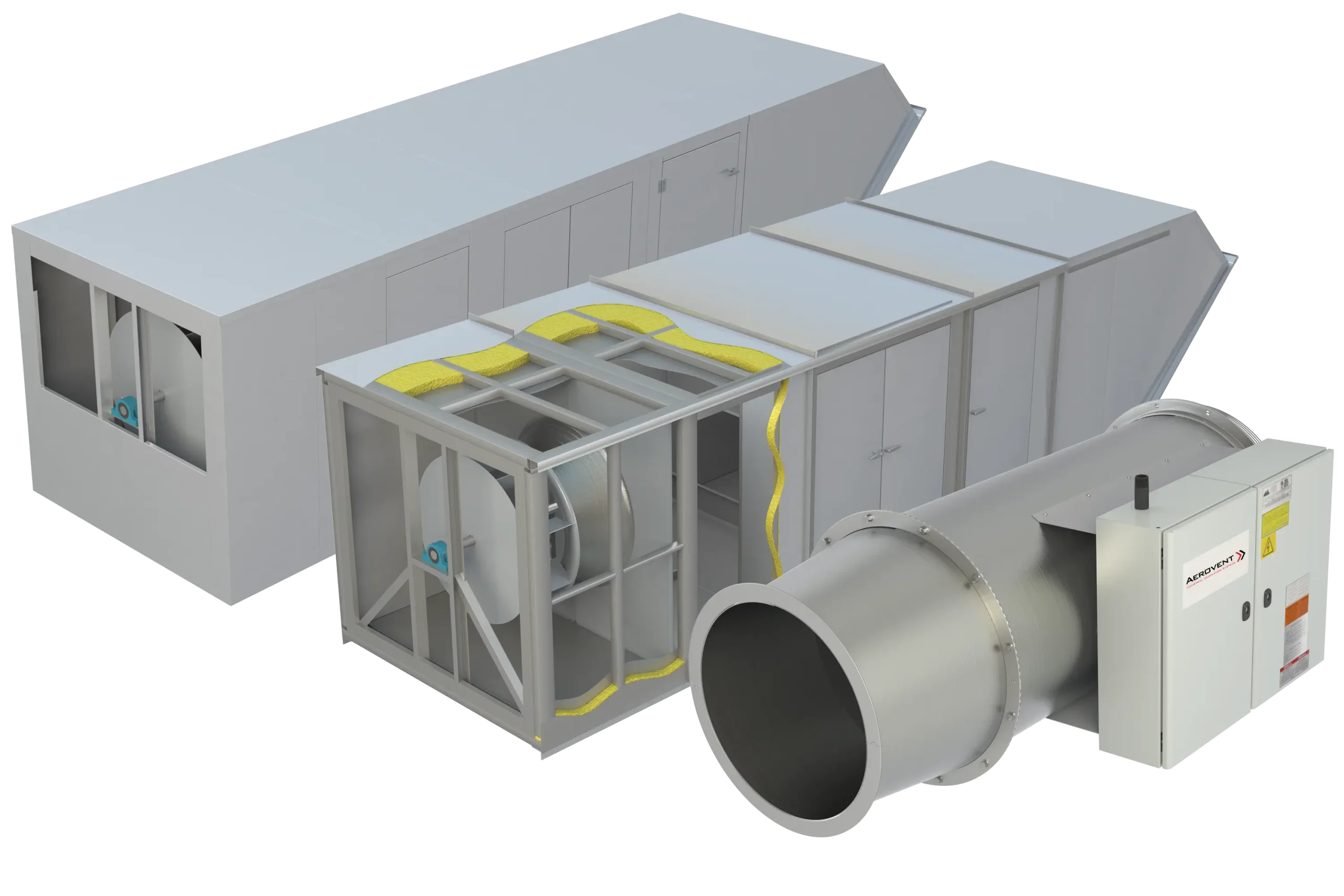
Air-handling units house fans, coils, filters, mixing boxes, and controls that condition and distribute air. Their performance sets system baseline efficiency. Key choices include fan type (plug/plenum vs. housed centrifugal), coil rows and fin density, and whether to use energy recovery devices such as enthalpy wheels or plate exchangers. High-efficiency fan arrays with electronically commutated motors (ECMs) or VFD-driven motors maintain static pressure while modulating to actual demand.
Well-designed AHU sections reduce bypass, minimize casing leakage, and facilitate maintenance access. Casing leakage class and thermal bridging influence energy use and moisture control. In humid climates, reheat strategies for dehumidification must be weighed against energy codes; energy recovery or decoupled dedicated outdoor air systems (DOAS) can manage latent loads more efficiently.
Filters remove particulates and, in specialized systems, gases. ASHRAE Standard 52.2 defines the Minimum Efficiency Reporting Value (MERV), which classifies filters by their efficiency across particle size ranges. Higher MERV increases capture of smaller particles but also raises pressure drop, which requires higher fan power or greater filter surface area. Designers should place differential pressure taps across filter banks for monitoring and establish initial and final resistance setpoints.
| MERV Rating | Typical Particle Capture | Common Applications | Design Considerations |
|---|---|---|---|
| MERV 8 | 3–10 μm | Basic commercial prefiltration | Low pressure drop; limited fine particulate capture |
| MERV 11–13 | 1–3 μm | Offices, schools, healthcare support areas | Balanced IAQ and energy; verify fan capacity for ΔP |
| MERV 14–16 | 0.3–1 μm | Critical healthcare, labs | Higher resistance; often used with prefilters |
| HEPA (not MERV) | ≥99.97% at 0.3 μm | Isolation rooms, cleanrooms | Very high ΔP; specialized housings and seals |
Filter selection should be linked to outdoor air quality (e.g., PM2.5 levels), indoor activities, and the need to mitigate smoke or allergens. In high-smoke regions, consider activated carbon or other sorbent media for gaseous contaminants, with attention to media life and pressure drop.
Balancing and control dampers regulate airflow and enable zone-level tuning. Economizer dampers coordinate outdoor and return air proportions. In fire and smoke scenarios, code-compliant dampers isolate zones to protect egress routes and maintain compartmentalization. Device selection should reference UL 555 (fire) and UL 555S (smoke) listings where applicable, and control sequences must ensure fail-safe closing and periodic testing.
Diffusers, grilles, and registers determine terminal air distribution patterns, throw, and noise. Proper selection and placement prevent drafts, reduce stratification, and maintain effective mixing at reduced VAV flows. Designers should match diffuser performance data to anticipated turndown ratios to avoid loss of throw at minimum flows.
Energy use in ventilation systems is dominated by fan power and conditioning of outdoor air. Variable air volume reduces fan energy by decreasing flow and static pressure at part load. Static pressure reset and supply air temperature reset can further optimize operating points. In climates with substantial enthalpy differentials, energy recovery ventilators (ERVs) transfer heat and, in many designs, moisture between exhaust and supply, lowering coil loads.
Duct leakage control is a low-visibility but high-impact strategy. Moving from a poorly sealed system (10–20% leakage) to a well-sealed one (<5%) can reduce fan energy, improve delivered ventilation, and provide more predictable pressurization. During design, specify leakage class targets and sealing methods; during construction, enforce testing and remediation. Coil selection with appropriate approach temperatures and air velocities reduces coil pressure drops and reheat penalties, supporting overall commercial HVAC efficiency.
| System Type | Control Method | Energy Implication | Notes |
|---|---|---|---|
| CAV (constant air volume) | Constant flow; temperature varies | Higher fan energy at part load | Simpler controls; suitable for uniform loads |
| VAV (variable air volume) | Flow varies with demand | Lower fan energy; requires control tuning | Maintain minimum ventilation per zone |
| DOAS + terminal units | Decoupled latent/sensible | Efficient latent control; right-sized terminals | Effective in humid climates; more components |
| ERV-integrated AHU | Heat/moisture exchange | Reduced heating/cooling loads | Bypass/defrost logic in cold climates |
IAQ optimization begins with calculating outdoor air per ASHRAE 62.1’s multiple-space equations, then ensuring zone-level delivery with diversity and occupancy schedules. Carbon dioxide sensors can inform demand-controlled ventilation where allowed by code, moderating outdoor air intake during low occupancy while maintaining minimums in critical areas. Upgrading filters to MERV 13 often yields measurable IAQ improvements for most offices and schools, but increases resistance; compensating with deeper filter banks or higher media area reduces pressure drop.
In spaces with localized emissions (e.g., printing, welding), source capture or dedicated exhaust prevents contaminant spread, supporting lower general dilution rates. Zonal pressurization strategies (positive for clean areas, negative for dirty zones) depend on balanced supply and exhaust and tight duct systems. Validate with pressure monitoring across zones and between building and outdoors to maintain intended air flow direction.
Lifecycle costs dominate in ventilation systems. First-cost savings from smaller fans or coils can be erased by years of elevated energy use or unplanned maintenance. Consider trade-offs in filter selection (e.g., MERV 13 with V-bank frames vs. MERV 11 with higher outdoor air) through energy modeling. Energy codes (ASHRAE 90.1/IECC) increasingly reward designs with ERV, VAV with static reset, and effective fan power limits.
Procurement teams should weigh standardization benefits—such as common filter sizes and VFD models—against performance compromises. Where the building program may change, design for scalability: oversize filter racks for potential MERV upgrades, allow coil face area growth, and reserve panel space for additional control points. Commissioning and thorough test-and-balance at turnover avoid costly post-occupancy corrections and ensure predicted commercial HVAC efficiency is realized.
For a conceptual refresher on airflow control logic and economizer operation, consult how HVAC ventilation works to align sequence-of-operations with design intent.
Sites affected by roadway emissions, industrial neighbors, or wildfire smoke demand enhanced filtration and intake design. Locate air intakes away from pollutant plumes and at elevations with lower contaminant concentration where feasible. Use MERV 13–16 or HEPA in sensitive spaces, pairing with adequate prefiltration to extend media life. Incorporate gas-phase filtration where ozone, VOCs, or smoke odors are a concern, and provide secure access for media replacement.
Duct sections in polluted zones should be tightly sealed and, where outdoors, protected from infiltration and weather. Consider corrosion-resistant materials or coatings for intakes exposed to salt or industrial chemicals. Increased monitoring (PM2.5 sensors at intake, filter differential pressure trending) supports timely operational responses during pollution events.
Cold climates necessitate freeze protection for coils, preheat strategies, and insulated and vapor-sealed ductwork to prevent condensation. In very hot or humid climates, latent load handling becomes primary: DOAS with low dewpoint supply, hot-gas reheat, or ERV with high latent effectiveness should be assessed. Weather-rated dampers and low-leakage outdoor air dampers reduce uncontrolled infiltration that otherwise elevates load and undermines pressurization.
Material durability must match climate cycles. Thermal breaks in AHU casings limit condensation. In roof-mounted equipment, UV and wind exposure affect duct jackets; specify robust cladding and securement. Intake louvers require proper free area and rain rejection characteristics to avoid water carryover into filters, which degrades performance and increases pressure drop.
Commercial office buildings typically benefit from VAV with MERV 13 filtration and economizers, with conference rooms and high-density zones designed for higher ventilation and CO2 sensing. Retail spaces face door-induced infiltration and variable foot traffic; vestibules and demand ventilation moderate these effects.
Industrial buildings need tailored ventilation systems around process loads. Source capture arms, high-rate exhaust, and make-up air units maintain negative pressure in process areas while keeping adjacent spaces neutral or positive. Some processes require stainless ducts, spark-resistant fans, or explosion-proof components based on hazard classification.
Routine inspection sustains design performance. At minimum, seasonal checks should verify damper operation, sensor calibration, and filter integrity. Annual or semi-annual testing and balancing (TAB) confirms airflow setpoints, terminal device function, and pressure relationships between zones. Trend logs from the building automation system (BAS) identify drifting setpoints, stuck actuators, or filters reaching end of life.
Filter schedules should reference measured pressure drop rather than time alone. Establish initial and final ΔP thresholds and adjust intervals based on actual loading. In dusty or smoke-prone regions, plan for event-based replacement. Inspect prefilter and final filter frames to ensure no bypass, and verify gasket compression. Periodic duct inspections and targeted resealing maintain leakage below 5%, preserving ventilation delivery and reducing fan energy.
Key performance indicators include fan kW per CFM, outside air intake accuracy versus design, zone CO2 levels during occupied hours, and coil approach temperatures. Benchmarking these values after commissioning provides a baseline to detect degradation. Deviations—such as rising kW/CFM or chronic low supply static—indicate clogged filters, damper misalignment, or duct leakage increases.
A 60,000 ft² office building adopted VAV with a central AHU rated for 20,000 CFM. Using ASHRAE 62.1, the design outdoor air totaled 5,000 CFM based on occupant density and area. A MERV 8 prefilter plus MERV 13 final filter improved IAQ while limiting the added pressure drop to 0.35 in. w.g. at each bank due to deep-pleat selections. Ductwork used round mains with smooth-radius elbows, sealed to achieve under 3% verified leakage. Post-occupancy BAS trends showed a 28% reduction in average fan kW versus a CAV baseline, with zone CO2 remaining below 900 ppm in peak conditions.
A hospital expansion required isolation rooms with negative pressure and operating suites with positive pressure relative to adjacent spaces. AHUs included MERV 14 final filtration, with HEPA terminal boxes serving ORs. Differential pressure sensors and air valves maintained +/-0.03 in. w.g. pressure offsets. A heat recovery wheel preconditioned 30% outdoor air, reducing chiller load by approximately 15% during design day. The design coordinated smoke control with fire and smoke dampers to maintain compartmentalization while ensuring continued exhaust from isolation rooms during alarm events. Commissioning confirmed air changes per hour and pressure differentials, and maintenance staff received procedures for regular filter integrity checks.
A metal fabrication shop implemented source capture at welding stations and a 30,000 CFM general exhaust to manage fugitive emissions. Make-up air units supplied tempered air to maintain slight negative pressure in the process hall and neutral pressure in adjoining offices. Duct materials near the process were upgraded to stainless steel to resist corrosion from fumes, and all joints were gasketed to reduce leakage and pollutant egress. Filtration comprised MERV 11 prefilters and MERV 16 final filters in the return path to protect recirculating AHUs serving administrative areas. After startup, measured particulate levels at office returns fell by over 60% compared to pre-retrofit, and fan energy decreased due to redesigned duct mains that lowered system static by 0.6 in. w.g.
In a northern climate K-12 school, DOAS units delivered 45°F dewpoint air to classrooms, decoupling latent load from classroom fan coils. Enthalpy wheels with bypass and frost control transferred energy from exhaust to supply, cutting heating energy while maintaining ventilation. Duct insulation and vapor barriers were detailed at penetrations to prevent condensation. CO2-based demand control lowered outdoor air during partial occupancy while maintaining per-zone minimums per ASHRAE 62.1. Wintertime monitoring showed stable indoor relative humidity between 30–40% without window condensation, and utility bills tracked 12% below projections that assumed no energy recovery.
Successful HVAC ventilation design ties IAQ, comfort, and energy together with an emphasis on controllability and maintenance. Beginning with a clear ventilation basis of design—occupancy profiles, process loads, and outdoor air quality—engineers can size outdoor air, filtration, and air distribution to meet standards without overburdening fans or coils. Decisions about duct geometry, materials, and sealing translate directly to lifecycle energy and IAQ outcomes.
When choosing components and strategies, consider the following:
For procurement and facility teams, lifecycle thinking is critical: filter cost and change intervals, energy from fan power and conditioning outdoor air, and staff time for inspections. Early collaboration with contractors and commissioning agents reduces risk that systems fail to deliver the intended airflows and IAQ at reasonable cost.
Every project has unique drivers—climate, program, contaminants, and budget. To stress-test design options or review drawings and BOQs for constructability and performance, share your project details for an engineering-focused assessment. For deeper technical references and planning tools, explore our HVAC insights and design resources.
HVAC insights and design resources
HVAC ventilation systems require a careful balance between air quality, thermal comfort, energy use, and maintenance efficiency. Engineers must consider spatial constraints, occupancy dynamics, filtration impacts, and compliance with standards like ASHRAE 62.1 and 55 to optimize system performance. Design choices—such as duct configuration, fan capacity, filter selection, and control strategies—affect static pressure, airflow consistency, and long-term operational costs.
Integrating features like variable air volume systems, energy recovery devices, and targeted pressurization enhances efficiency while meeting specific site conditions like extreme weather or high pollution levels. Collaboration during design and construction phases ensures sealing, flow validation, and adaptability are embedded into lifecycle planning. Success lies in aligning technical requirements with practical execution, supported by testing, monitoring, and maintenance protocols.
Project-specific evaluations refine these principles further, offering tailored strategies to meet diverse building and environmental needs. Engage with specialized resources to ensure system goals translate seamlessly into real-world functionality.